

DeFi Oversight Gaps U.S. effort to modernize crypto regulation is colliding with one of the hardest questions in financial law: who is responsible when a system is designed to have no obvious operator? That tension surged after the Senate Judiciary Committee raised alarms about DeFi oversight gaps in a major U.S. crypto market-structure proposal often discussed as a “crypto bill” aimed at clarifying how digital assets should be regulated. The message from Judiciary is straightforward: if lawmakers carve out protections for certain developers or non-custodial software, does the bill accidentally create DeFi oversight gaps that weaken enforcement, invite abuse, or leave consumers exposed?
This is not just a technical drafting dispute. It is a high-stakes debate about the future of decentralized finance, the role of smart contracts, and how the United States defines legal accountability in systems built from open-source code and distributed networks. On one side, many builders argue that writing code should not be treated like running a bank. They say that classifying software development as a regulated financial service risks criminalizing innovation and driving talent offshore. On the other side, enforcement-focused lawmakers and prosecutors worry that overly broad safe harbors could become a blueprint for evading compliance—turning decentralization into a legal shield rather than a design principle.
In this article, we’ll break down why the Senate Judiciary Committee is spotlighting DeFi oversight gaps, what those gaps might look like in practice, how developer protections intersect with money transmitter laws and anti-money laundering expectations, and what a workable compromise could involve. You’ll also learn how this debate connects to the long-running SEC vs CFTC jurisdiction fight, why the “interface layer” is becoming the center of gravity for policy, and what all of this means for investors, users, and builders who want predictable rules without suffocating a fast-moving ecosystem.
Why Senate Judiciary is focusing on DeFi oversight gaps
Different Senate committees look at crypto through different lenses. A banking-focused lens emphasizes financial stability, consumer harm, and the regulatory perimeter around investment products. An agriculture-focused lens tends to look at commodities and derivatives markets. The Judiciary lens is distinct: it prioritizes criminal enforcement, liability, legal definitions that prosecutors depend on, and whether new statutory language narrows or expands the government’s ability to pursue wrongdoing.
That’s why DeFi oversight gaps are such a Judiciary-style concern. If a crypto bill includes language that prevents certain DeFi participants from being treated as operators of financial services—especially when they do not custody funds—Judiciary may see a risk that the legal system loses leverage against illicit activity. The worry is not only about intent. Even well-intended language can create uncertainty in court, where ambiguity often benefits defendants. A defense attorney doesn’t need to prove the law is wrong; they only need to show that it is unclear enough to raise doubt about how it applies.
At the same time, it’s important to understand why developer protections exist in the first place. DeFi is built on code that users execute themselves. If a user interacts directly with a smart contract from a self-custody wallet, it is not obvious that any developer “received and transmitted” money the way a traditional payment intermediary does. If lawmakers cannot draw a clean line between writing software and operating a value-transfer business, the fear is that ordinary open-source development becomes legally risky. So Judiciary pressure is really a demand for precision: reduce DeFi oversight gaps without turning coders into regulated institutions.
What the crypto bill is trying to accomplish
A modern U.S. crypto market-structure bill typically has three broad goals. First, it tries to clarify definitions: what is a digital commodity, what is a security, what is an exchange, what is a broker, and what is a decentralized protocol. Second, it tries to establish an oversight framework that assigns primary responsibility to a regulator—commonly the SEC for securities-like assets and the CFTC for commodity-like assets—while also addressing registration and compliance obligations for intermediaries. Third, it aims to reduce the current policy chaos, where many rules are interpreted through enforcement actions and court disputes rather than clear statutes.
Those goals sound straightforward, but DeFi stretches every category. A single DeFi protocol can host token swaps, derivatives-like exposures, lending markets, and governance structures—without an incorporated company running the core contracts. Meanwhile, user access often occurs through a web interface or aggregator that looks and feels like a conventional fintech app. The more the bill tries to cover the full ecosystem, the higher the risk of DeFi oversight gaps created by edge cases and modular architecture.

In other words, the bill is attempting to “map” a new kind of financial activity onto a framework built for centralized institutions. That is why DeFi becomes the stress test. If the bill gets DeFi wrong—either by allowing loopholes or by overregulating code—its credibility and long-term effectiveness both suffer.
How developer protections became the flashpoint
Developer protections have become one of the most contentious issues in U.S. crypto policy because they sit at the intersection of technology, free expression, and financial crime prevention. In the DeFi worldview, the protocol is software, and the user is the one who initiates transactions. The developer might never touch the funds. This is fundamentally different from a custodial exchange or a payment processor, where the intermediary takes possession of customer assets or directly routes transfers on their behalf.
However, real-world DeFi has evolved. Many projects are not just “code on a blockchain.” They maintain branded front ends, provide user support, curate token lists, optimize routing, collect fees, and coordinate governance. That makes the developer-versus-operator distinction harder. A crypto bill that tries to protect “developers” must define what that means. If the definition is too broad, it creates DeFi oversight gaps where actors who function like intermediaries can claim they are merely publishing software. If the definition is too narrow, it undermines the very goal of protecting neutral toolmaking.
This is why Judiciary scrutiny matters: it pressures lawmakers to write definitions that withstand courtroom reality rather than marketing narratives.
The legal core: money transmission, facilitation, and liability
A recurring legal fault line in crypto policy is the concept of money transmission. In the traditional world, money transmitters are businesses that accept value from one person and transmit it to another. They must register, implement compliance programs, and meet obligations tied to AML, sanctions, and reporting. The DeFi question is whether certain participants—developers, validators, liquidity providers, interface operators—fit that definition.
The Senate Judiciary concern about DeFi oversight gaps often emerges when a bill tries to create a safe harbor: language that says software development or network maintenance does not automatically constitute money transmission. Safe harbors can be crucial for innovation, but they need careful boundaries. If a person or entity has meaningful control over transactions, collects fees, or operates a consumer-facing service that actively facilitates transfers, it becomes harder to justify blanket exemptions.
What complicates the issue is that DeFi is layered. The base layer is the smart contract. Above it sit routers, aggregators, interfaces, analytics tools, and sometimes custodial wrappers. Each layer can change the legal character of the activity. A bill that only focuses on the base layer may inadvertently create DeFi oversight gaps at the layers where real-world control and consumer interaction happen.
What “DeFi oversight gaps” could look like in practice
To understand the debate, it helps to translate it into practical scenarios. DeFi oversight gaps are not an abstract concept; they’re about how bad outcomes occur, where responsibility sits, and whether the law can identify accountable actors.
Interfaces as the real-world control point
Most users do not read contract code or interact through raw command-line tools. They use a web interface or app that chooses defaults, displays token information, and routes transactions. The entity operating the interface can decide what markets appear, what warnings are shown, what jurisdictions are blocked, and whether transaction screening occurs. If the law treats interface operators as mere “publishers” in all cases, it may create DeFi oversight gaps because the interface is the point where consumer protection and risk mitigation are most feasible.
At the same time, not all interfaces are centralized. Some are open-source, mirrored, or hosted in decentralized ways. That’s why the key is not simply “interface equals intermediary,” but whether the interface operator has ongoing control, monetization, and the ability to shape outcomes.
Governance as functional operation
Many DeFi protocols use governance systems that can change parameters, direct treasury funds, or upgrade contract logic. Some systems have admin keys or emergency controls. Others rely on token-based voting, which can be concentrated in a small number of wallets. A protocol may claim decentralization while a handful of actors effectively steer major decisions. If legislation assumes governance is meaningfully distributed just because it exists, that assumption can generate DeFi oversight gaps where functional operators escape accountability.
A more realistic approach recognizes decentralization as a spectrum. The question becomes: who can influence outcomes in a way that resembles an operator? The legal system often cares less about branding and more about control.
Fee collection and monetized routing
When a protocol or interface collects fees, that revenue stream can incentivize ongoing management and marketing. Fee collection can also look like commercial operation rather than neutral software publication. If a bill does not address monetized facilitation, DeFi oversight gaps can emerge where profit-driven businesses frame themselves as passive developers while operating active value-transfer services.
Cross-chain bridges and complex routing
DeFi increasingly involves bridges, wrapped assets, and cross-chain swaps. These pathways can be exploited for hacks and laundering because they add complexity and move assets through multiple systems quickly. If a crypto bill focuses on centralized exchanges but leaves bridge-related services unclear, critics may view that as another set of DeFi oversight gaps—especially if the largest losses and enforcement challenges occur in cross-chain contexts.
How regulators fit into the DeFi oversight gaps debate
Even if Congress passes a crypto bill, regulators still shape outcomes through guidance, rulemaking, examinations, and enforcement. The debate over DeFi oversight gaps is closely tied to three regulatory themes: jurisdiction, AML expectations, and consumer protection.
The SEC vs CFTC boundary problem
One reason market-structure legislation exists at all is the long-running uncertainty over whether certain digital assets are securities or commodities. The SEC has often emphasized investor protection and disclosure obligations, while the CFTC emphasizes market integrity in commodity and derivatives contexts. For DeFi, the boundary can blur because protocols can offer both spot trading-like activity and derivatives-like exposure through perpetuals, leveraged tokens, or synthetic assets.
When a bill tries to clarify agency roles, it must also address how decentralized venues fit. If a protocol acts like an exchange but has no obvious operator, does it register? Who is responsible for compliance? Without a clear answer, DeFi oversight gaps can appear where the activity is economically similar to regulated markets but structurally harder to supervise.
FinCEN, AML, and the compliance question
The other major dimension is FinCEN-style compliance expectations—KYC, suspicious activity monitoring, and sanctions screening. Traditional AML frameworks assume an intermediary that can identify customers and monitor flows. DeFi challenges that assumption. Yet policymakers remain focused on preventing illicit finance, especially in systems that can move funds globally and quickly.
This creates a dilemma: If a bill imposes bank-like obligations on protocol code, it becomes unworkable and harms innovation. If it imposes no obligations on any layer, critics warn of DeFi oversight gaps that make crime easier. The practical solution many discuss is focusing on entities that provide access and services—particularly where there is custody, control, or monetized facilitation.
Consumer protection in non-custodial systems
Consumer protection in DeFi is also complicated. Users can lose money through hacks, exploits, misleading token listings, and risky leverage mechanisms. In non-custodial contexts, users often bear more responsibility, but that doesn’t mean consumer harm is acceptable or unavoidable. A crypto bill that ignores how users actually experience DeFi—mostly through interfaces and aggregators—can deepen DeFi oversight gaps by leaving the most influential consumer-facing layer underdefined.
The central tradeoff: closing gaps without criminalizing code
At the heart of this policy fight is a tradeoff between two real risks.
The first risk is that laws become so broad that they treat software publication like operating a financial institution. That can discourage open-source development, reduce transparency, and push innovation into less visible jurisdictions. It can also create a chilling effect where builders avoid security research, auditing, and tooling because they fear liability.
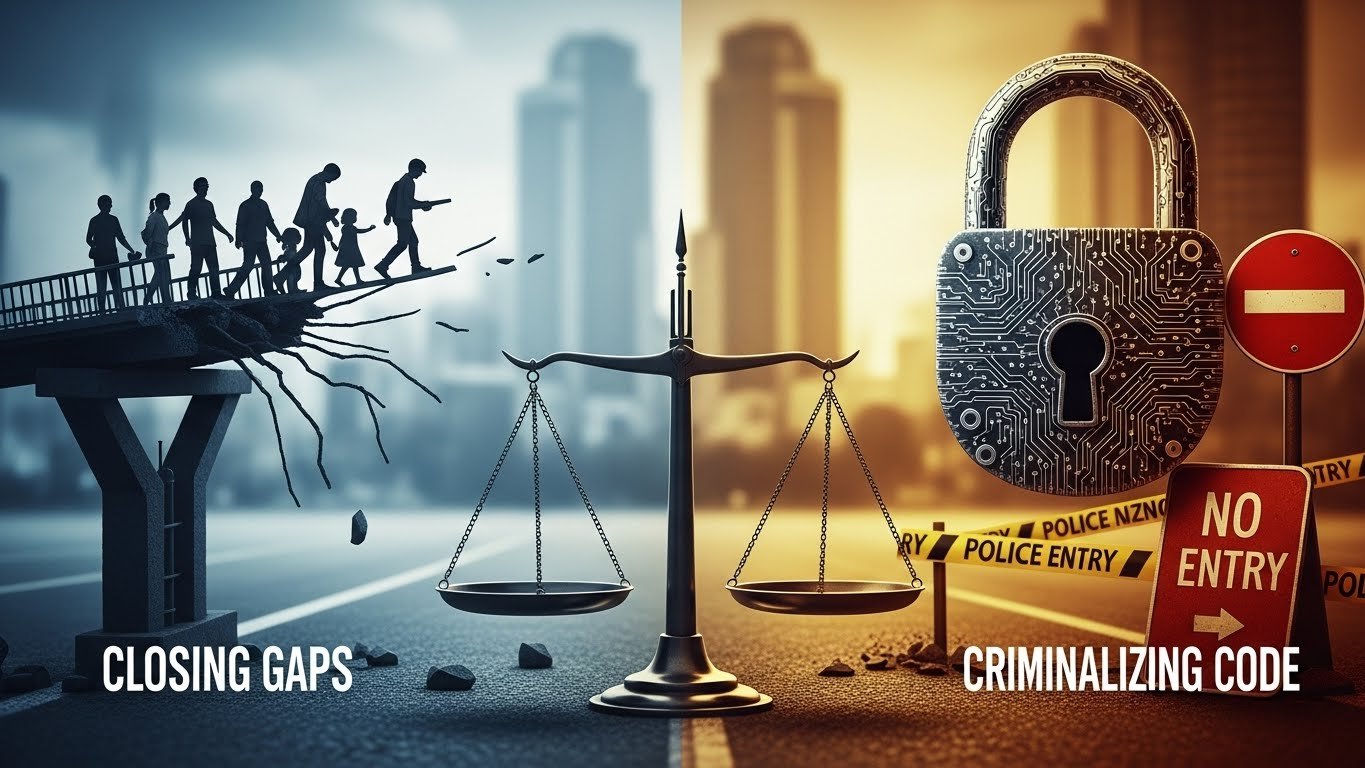
The second risk is that laws become so narrow that they create DeFi oversight gaps where powerful actors escape responsibility by claiming they’re merely “developers.” In that world, someone could run a consumer-facing product, collect fees, and shape transactions, while leaning on safe-harbor language to resist compliance and enforcement. That risks turning decentralization into a regulatory loophole rather than a technical architecture.
A balanced approach usually tries to regulate functions rather than labels. Instead of asking whether something is “DeFi,” policymakers can ask what the actor does: Do they custody assets? Do they control upgrades? Do they operate the primary access point? Do they monetize transaction facilitation? Do they market returns and manage risk like a financial service? The more an actor behaves like an intermediary, the less plausible it is to treat them as a neutral software publisher.
What smarter guardrails could look like
If lawmakers want to reduce DeFi oversight gaps while protecting legitimate developers, the best solutions often look like nuanced tests rather than sweeping claims.
A clearer standard for “control”
One way to avoid DeFi oversight gaps is to define “control” in ways that map to real-world power. Control could include custody over user funds, unilateral authority to change transaction logic, possession of admin keys, exclusive control of the main interface with monetization, or the ability to block or prioritize transactions. A clear control standard helps the law target the actors who can actually prevent harm, without dragging in everyone who contributed code.
Distinguishing code publication from product operation
Another guardrail is separating open-source publication from operating a service. Publishing a smart contract or library is different from running a branded application that curates markets, charges fees, provides customer support, and markets financial outcomes. If the bill can describe that distinction clearly, it can narrow DeFi oversight gaps while maintaining protections for core development.
This distinction also supports innovation: developers can build tools and protocols openly, while businesses that package DeFi into products can comply with tailored obligations appropriate to their role.
Making room for decentralization while preventing “decentralization theater”
A persistent issue in crypto is “decentralization theater,” where projects claim decentralization while retaining concentrated control. Laws that treat decentralization as a checkbox can create DeFi oversight gaps. Better guardrails treat decentralization as a set of measurable attributes: distribution of governance power, absence of privileged keys, verifiable inability to unilaterally upgrade, and transparent processes for changes.
The goal is not to punish decentralized design, but to prevent the misuse of decentralized branding as a legal shield.
Aligning compliance with practical access layers
Because base-layer smart contracts cannot do identity checks in the same way banks do, many realistic compliance strategies focus on access layers—interfaces, aggregators, custodial wrappers, and fiat on-ramps. If a crypto bill wants to reduce DeFi oversight gaps, it can recognize this reality and set expectations where compliance is feasible. That might mean obligations for certain service providers, while explicitly protecting non-custodial software development that lacks control over user funds and transactions.
What this means for builders, platforms, and users
The Judiciary spotlight on DeFi oversight gaps matters because it can reshape the final bill in ways that influence day-to-day crypto activity.
For builders, the outcome determines whether they can develop smart contract infrastructure and open-source tools without fear of being treated as money transmitters. It also affects whether operating a front end or collecting protocol fees triggers additional obligations.
For platforms, the bill could change how exchanges integrate DeFi, how token listings are evaluated, and how compliance teams manage exposure to decentralized markets. It may also influence how custodial services interact with non-custodial protocols.
For users, the debate could affect access. If the law pushes more responsibility onto interfaces, users may see more geoblocking, more warnings, and more compliance friction. If the law leaves too much ambiguous, users may face greater risk of scams and unsafe products—one of the practical consequences of DeFi oversight gaps.
The broader industry impact is also significant. Clear rules can bring activity onshore, encourage institutional participation, and reduce the reliance on enforcement-driven policymaking. But clarity that is perceived as unfair—or loophole-ridden—can backfire, either by driving builders away or by eroding public trust after high-profile failures.
Conclusion
The Senate Judiciary Committee’s warning about DeFi oversight gaps highlights a defining challenge for U.S. crypto regulation: writing laws that can identify responsibility in systems built to minimize centralized control. The policy path forward is not to treat code as a financial institution, nor to treat decentralization as a magic exemption. It is to focus on functional realities—control, custody, monetized facilitation, and the consumer-facing layers where influence is strongest.
If lawmakers can craft a crypto bill that protects open-source development while holding true operators accountable, the U.S. can reduce DeFi oversight gaps and promote responsible innovation. If they fail, the country risks either loopholes that undermine enforcement or overbroad rules that chill development and push activity offshore. The Judiciary intervention makes one thing clear: DeFi is no longer a niche topic in crypto policy—it is the central battlefield where the future of U.S. digital asset regulation will be decided.
FAQs
Q: What does “DeFi oversight gaps” mean in plain English?
DeFi oversight gaps refers to areas where decentralized finance activity may not fit neatly into existing rules, making it unclear who must follow compliance obligations or who can be held accountable when harm occurs.
Q: Why would a crypto bill include developer protections?
Developer protections aim to prevent people who write or publish software from being treated like financial intermediaries when they don’t custody user funds or control transactions. The goal is to support innovation and open-source development.
Q: How can developer protections create DeFi oversight gaps?
If protections are too broad or vague, DeFi oversight gaps can emerge where actors who effectively operate a DeFi service—especially through interfaces, fee collection, or upgrade controls—can claim they are merely developers and avoid obligations.
Q: Who might regulators focus on if they can’t regulate smart contracts directly?
Regulators often focus on access points and service providers, such as custodial platforms, fiat on-ramps, and interface operators that exercise control or monetize facilitation. This is one strategy to reduce DeFi oversight gaps without trying to regulate code itself.
Q: What should DeFi users watch for as regulation evolves?
Users should watch how rules affect interface access, disclosures, token availability, and safeguards against scams or hacks. Changes intended to close DeFi oversight gaps may improve safety but could also introduce friction like geoblocking or additional verification steps.
Also More: Solana DeFi Exchange Jupiter Unveils JupUSD Stablecoin
