

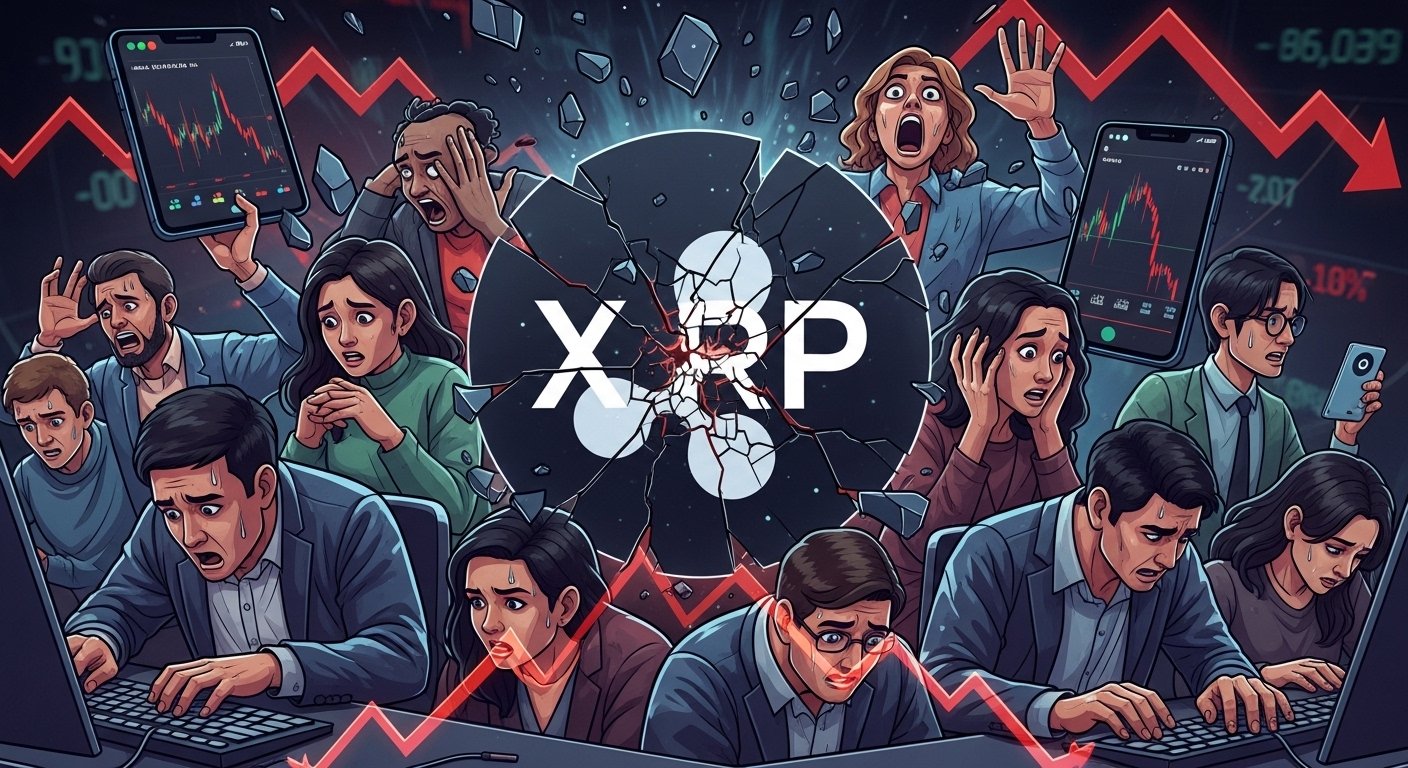
XRP Panic Selling as Holder has once again found itself at the center of market anxiety. As price volatility increases and confidence weakens, many investors are beginning to feel the pressure of unrealized and realized losses. The phrase “XRP sees panic selling as Glassnode data shows significant holder losses” captures a critical moment where emotion and data intersect. While short-term price movements often dominate headlines, on-chain analytics provide a deeper and more revealing look at what XRP holders are actually doing.
Panic selling is not merely a dramatic term used by commentators; it reflects a behavioral shift where investors choose to exit positions at a loss rather than risk further downside. When this behavior becomes widespread, it signals stress across the market. Recent on-chain indicators show that a significant portion of XRP supply has been sold below its acquisition price, highlighting growing discomfort among holders.
This article explores what panic selling really means for XRP, why holder losses matter, and how these developments shape price action and investor psychology. By examining cost basis dynamics, realized losses, and broader market structure, we can better understand whether XRP is approaching exhaustion—or facing further downside.
What Panic Selling Means in the XRP Market
Panic selling occurs when fear overrides strategy. In the XRP market, this behavior often emerges after sharp price declines or failed attempts to reclaim key resistance levels. Investors who initially planned to hold long-term may suddenly decide to sell simply to avoid deeper losses.
From a behavioral standpoint, panic selling is most visible when holders sell XRP at prices below their original entry point. This action converts paper losses into realized losses, locking in financial pain. When this behavior becomes widespread, it indicates that confidence has eroded across a broad segment of the market.

Unlike orderly profit-taking, panic selling tends to be fast, emotional, and clustered around critical price levels. It often coincides with heightened volatility, negative sentiment on social platforms, and increased trading volume. These moments are uncomfortable, but they also provide valuable insight into market structure and participant psychology.
Holder Losses Through On-Chain Data
On-chain data allows analysts to track how and when XRP moves between wallets, offering insight into investor behavior beyond price charts. One of the most important concepts in this context is realized loss.
Realized Loss and Why It Matters
Realized loss measures the value of XRP sold at a price lower than the price at which it was last moved on-chain. In simple terms, it tracks when investors give up and sell at a loss. When realized losses increase sharply, it suggests that many holders are capitulating rather than waiting for recovery.
Rising realized losses often accompany panic selling phases. They indicate that selling pressure is coming from stressed investors rather than confident profit-takers. This distinction is crucial because it helps determine whether a sell-off is healthy consolidation or a sign of deeper weakness.
Cost Basis and Investor Stress
Another critical on-chain concept is cost basis, which represents the average price at which current holders acquired their XRP. When market price falls below the aggregate cost basis, the majority of holders are underwater. This situation tends to amplify emotional responses, as investors face the uncomfortable reality of unrealized losses.
If price remains below cost basis for an extended period, even small rallies can trigger selling as holders attempt to exit near breakeven. This behavior contributes to repeated rejections at key levels and reinforces bearish sentiment.
Why XRP Holder Losses Can Accelerate Selling Pressure
Holder losses do not exist in isolation. They often interact with psychological and structural factors that intensify selling pressure.
The Breakeven Effect and Overhead Supply
When a large number of XRP holders share similar entry prices, the market develops what is known as overhead supply. As price approaches these shared cost basis levels, many investors choose to sell simply to recover their capital. This creates resistance and limits upside momentum.
Repeated failures to break above these zones can frustrate buyers and embolden sellers, reinforcing the cycle of panic selling. Over time, this dynamic can suppress price recovery even in the absence of negative news.
Leverage and Forced Selling
Although on-chain data primarily reflects spot market behavior, derivatives trading plays a significant role in amplifying price movements. When price drops sharply, leveraged positions may be liquidated, forcing additional selling. This cascade can push price lower than expected, triggering panic among spot holders who were otherwise willing to wait. The combination of forced liquidations and voluntary panic selling often results in sharp, fast declines that feel disproportionate to the original catalyst.
XRP Market Structure and Emotional Price Levels
XRP is known for reacting strongly to specific price zones that carry psychological significance. These levels often align with historical highs, prior support, or widely discussed resistance areas.
Why Certain Levels Trigger Panic Selling
When XRP fails to reclaim a widely watched level, it can undermine investor confidence. Holders who expected a breakout may instead face renewed losses, prompting them to exit positions. This reaction is not purely technical; it is deeply emotional. On-chain data shows that these levels often coincide with concentrated cost basis clusters. When price falls below such zones, a large group of holders suddenly finds itself underwater, increasing the likelihood of panic selling.
Cost Basis Clusters and Market Fragility
Markets become fragile when many participants are positioned similarly. If most XRP holders entered around the same price range, any move below that range can trigger synchronized selling. This lack of diversification in entry points reduces market resilience and increases volatility. Understanding this structure helps explain why XRP sometimes experiences abrupt drops rather than gradual declines.
Interpreting Panic Selling: Bullish and Bearish Scenarios
While panic selling feels overwhelmingly negative, it does not always lead to further downside. The implications depend on how the market responds after losses are realized.
Bullish Interpretation: Seller Exhaustion
One potential outcome of widespread holder losses is seller exhaustion. Once the most reactive investors have sold, selling pressure may diminish. At this stage, price can stabilize even without strong buying interest, simply because fewer sellers remain. If XRP begins to consolidate while realized losses decline, it may indicate that the panic phase is ending. Long-term investors often look for these conditions as signs that risk is becoming asymmetric to the upside.
Bullish Interpretation: Accumulation by Stronger Hands
Another constructive interpretation is that experienced investors use panic selling events to accumulate XRP at discounted prices. These participants tend to have longer time horizons and are less sensitive to short-term volatility. If accumulation occurs during periods of high holder losses, it can gradually shift supply from weak hands to strong hands, improving market stability over time.
Bearish Interpretation: Prolonged Distribution
On the bearish side, panic selling can also signal the beginning of a longer distribution phase. If price continues to break key supports and holder losses keep rising, confidence may erode further. In this scenario, rallies are sold aggressively, and recovery attempts fail. This outcome is more likely if broader market sentiment remains weak or if external factors continue to pressure risk assets.
How to Use On-Chain Signals Without Overreacting

On-chain data is most powerful when used as part of a broader analytical framework. No single metric can predict price movements with certainty.
Watching the Trend in Realized Losses
The direction of realized losses matters more than the absolute number. Rising losses indicate increasing stress, while declining losses suggest stabilization. Monitoring changes over time helps differentiate between ongoing panic and post-capitulation recovery.
Combining On-Chain Data With Price Structure
On-chain insights should be paired with traditional analysis. Support and resistance levels, volume trends, and market momentum all provide context. When on-chain stress aligns with technical exhaustion, the probability of stabilization increases.
Broader Market Context and XRP Sentiment
XRP does not trade in isolation. Liquidity conditions, macroeconomic factors, and overall crypto sentiment influence how panic selling unfolds. When risk appetite is low, negative feedback loops can intensify. When sentiment improves, even heavily stressed assets can rebound sharply. Understanding this context helps investors avoid emotional decisions driven by short-term fear.
Conclusion
XRP panic selling, accompanied by significant holder losses, represents a critical phase in the asset’s market cycle. It reflects a moment where fear dominates decision-making and where many investors choose certainty over hope by realizing losses.
On-chain data provides valuable clarity during these periods, revealing whether selling pressure is accelerating or beginning to fade. While rising losses increase short-term risk, they can also mark the transition from distribution to stabilization.
The key takeaway is not to view panic selling as inherently bullish or bearish, but to understand it as a process. How XRP behaves after this phase—whether it stabilizes, consolidates, or continues lower—will determine the next major trend.
FAQs
Q: What causes panic selling in XRP?
Panic selling is typically triggered by sharp price drops, failed breakouts, or prolonged trading below key cost basis levels. Fear of further losses pushes investors to sell quickly.
Q: Are holder losses always a bad sign for XRP?
Not necessarily. While rising losses indicate stress, they can also signal capitulation, which sometimes precedes market stabilization or recovery.
Q: How does realized loss differ from unrealized loss?
Unrealized loss exists when XRP is held below its purchase price. Realized loss occurs when that XRP is actually sold at a lower price, locking in the loss.
Q: Can XRP recover after panic selling?
Yes, recovery is possible if selling pressure subsides and demand returns. Many market bottoms form after periods of intense fear and loss realization.
Q: How should investors use on-chain data during volatile periods?
On-chain data should be used alongside price analysis and broader market context. It helps assess investor behavior but should not be relied on in isolation.
Also More: Top 3 Price Prediction BTC, ETH & XRP Stabilize
