


Bitcoin Slips as Oil Spikes is often marketed as a hedge—against inflation, against currency debasement, even against geopolitical uncertainty. Yet when markets wake up to a sudden, high-stakes shock, Bitcoin frequently trades like a high-beta risk asset, moving in the same direction as growth stocks and other speculative corners of finance. That’s exactly the setup when oil jumps sharply on fears of a widening conflict, and traders reprice everything from equities to bonds to currencies in real time.
In the latest jolt to global risk sentiment, oil prices spiked by roughly 6% as investors began pricing in an escalating U.S.-Iran conflict and the possibility of disruptions around key energy shipping routes. In the first broad market reaction after the escalation, Bitcoin fell back toward the mid-$60,000s—around $66,700 in early trading—while Asian equities slid and energy markets surged. This kind of cross-asset move matters because Bitcoin doesn’t trade in isolation anymore; it sits in a tightly connected ecosystem of liquidity, leverage, macro expectations, and institutional positioning.
So what’s really happening when oil spikes, global markets go risk-off, and Bitcoin comes under pressure? The answer is less about a single narrative—like “Bitcoin is digital gold” or “Bitcoin is tech”—and more about how geopolitical risk, inflation expectations, and financial conditions collide in a short window. In this article, we’ll unpack why Bitcoin and the broader crypto market can struggle during an energy shock, what signals to watch if the conflict risk intensifies, and how investors can think clearly when volatility rises across everything from crude oil to altcoins.
The macro trigger: Oil’s 6% jump and the conflict premium
When traders say “the market is pricing in conflict,” they mean risk is being converted into numbers: higher implied volatility, wider credit spreads, lower equity futures, and—crucially—higher energy prices. Oil reacts quickly because physical supply chains and shipping routes can be disrupted abruptly, and because crude is foundational to transport, industry, and consumer price indices.
Recent reports described oil surging on fears linked to intensifying Middle East tensions and potential stress around vital routes such as the Strait of Hormuz, a major chokepoint for global energy flows. Even a temporary increase in perceived disruption risk can push prices higher, because markets don’t wait for barrels to disappear; they move on probabilities. That’s the “war premium” in action.
For Bitcoin, the problem is that an oil shock doesn’t just raise energy prices. It can also lift expected inflation, alter the projected path of interest rates, and tighten liquidity—three forces that historically weigh on speculative assets, including many crypto tokens.
Bitcoin Slips as Oil Spikes a financial-conditions shock
A sharp rise in oil can feed into headline inflation quickly, and it can seep into broader price pressures via transportation and input costs. As investors recalibrate inflation expectations, bond yields can move, central-bank expectations can shift, and the cost of capital can rise. Even if policymakers look through a temporary spike, markets often trade the uncertainty first and debate the economics later.
That uncertainty tends to trigger a risk-off posture: investors de-lever, rotate into cash-like instruments, and favor assets with clearer cash flows and lower volatility. Bitcoin, despite its growing legitimacy, remains volatile—so it can end up in the “reduce exposure” bucket during the first wave of a macro shock.
Why Bitcoin can fall even when geopolitical risk rises
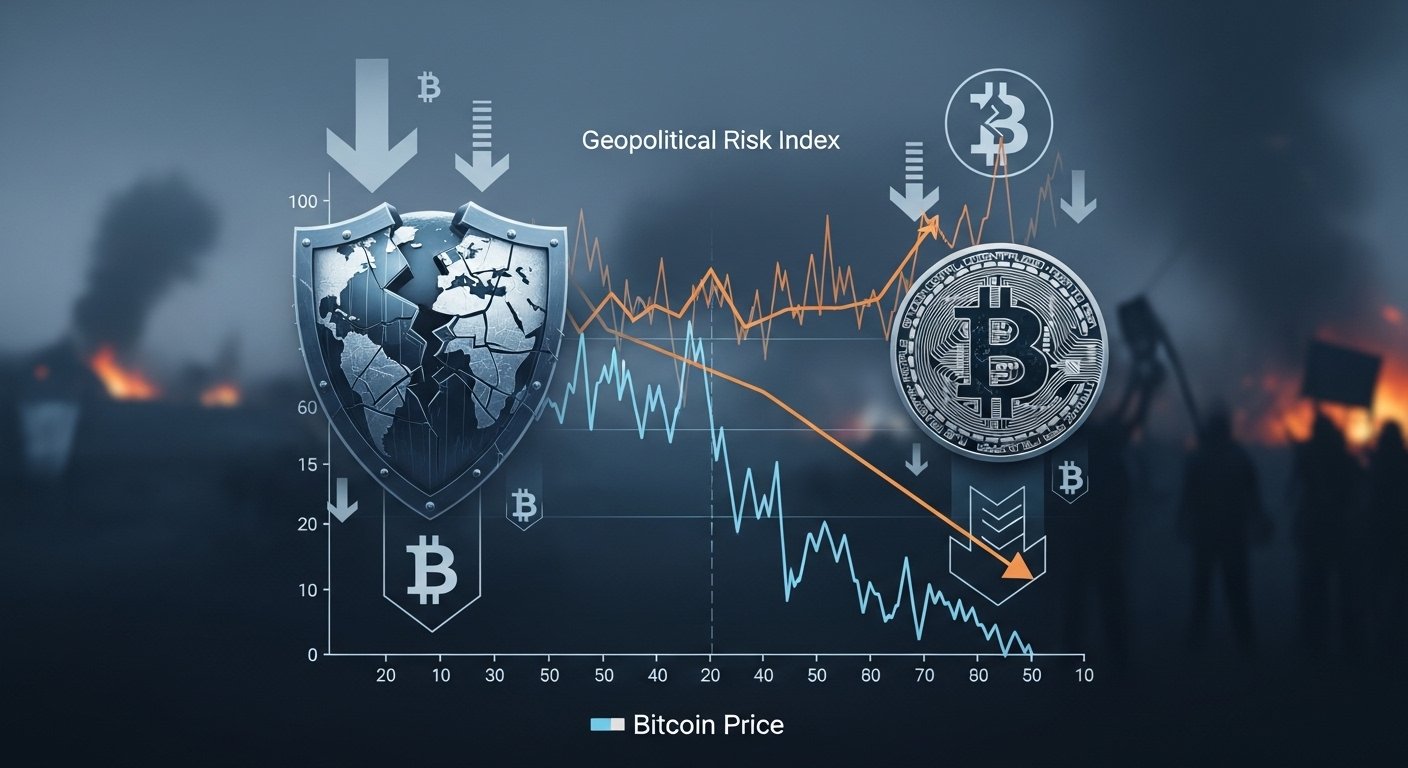
It feels counterintuitive: geopolitical stress is supposed to make alternative stores of value more attractive, and Bitcoin is often discussed in that context. But in practice, Bitcoin’s short-term behavior is shaped by market structure—derivatives, leverage, funding rates, and cross-asset correlations—at least as much as long-term ideology.
In the immediate reaction described by major market coverage, Bitcoin slipped as oil climbed and stock futures weakened, with gold also drawing flows as a more traditional safe haven. That mix—oil up, equities down, gold up—reflects classic risk repricing. Bitcoin often joins equities in that first move because it is widely held by traders who manage it alongside other risk exposures.
Correlation is a feature of liquidity cycles
During periods of abundant liquidity, Bitcoin can rally with everything else—tech stocks, high-yield credit, and speculative growth. When liquidity tightens, the reverse can happen: correlations converge, and Bitcoin trades like “macro beta.” In moments of heightened stress, the question isn’t whether Bitcoin is a store of value in theory; it’s whether market participants need to reduce volatility, meet margin calls, or close leveraged positions. That’s why “Bitcoin as hedge” can be true over certain horizons and contexts, while “Bitcoin as risk asset” can be true in the short-term reaction window—especially when oil shocks raise uncertainty about inflation and rates.
The oil–inflation–rates chain: the key pressure point for crypto
Crypto markets are extremely sensitive to the expected path of real interest rates and dollar liquidity. When oil spikes, traders quickly ask: will this complicate the inflation fight? Could it delay rate cuts? Does it raise the odds of tighter financial conditions? Even before any official policy changes, the expectation shift alone can pressure Bitcoin. Higher expected rates can strengthen the dollar, pull liquidity out of risk assets, and reduce the appeal of non-yielding assets. Bitcoin is non-yielding by design, so its relative attractiveness can weaken when cash yields look more compelling.
Energy costs can squeeze global growth expectations
Another reason Bitcoin can slip is that higher oil is a tax on consumers and businesses. If markets start pricing slower growth, the appetite for speculative exposure tends to fall. That can hit Bitcoin directly and hit altcoins even harder—because many altcoins behave like leveraged bets on crypto sentiment. When growth fears meet geopolitical fears, the result can be a fast, broad de-risking across digital assets, with the most liquid assets (like Bitcoin) sometimes sold first because they’re easiest to exit quickly.
What happens inside crypto when markets go risk-off
Crypto has its own internal mechanics that amplify macro shocks. Even if the initial trigger is oil and geopolitics, the crypto drawdown often deepens through leverage unwind, forced selling, and shifting derivatives positioning. In similar episodes, traders rush for downside protection, funding rates swing, and liquidations cascade when support levels break. That dynamic can make Bitcoin look “weaker than expected” relative to the narrative—when the reality is that leveraged positioning created fragility.
Bitcoin vs. altcoins: why the pain spreads unevenly
Bitcoin is usually the most resilient major crypto asset in a broad risk-off move because it is the most liquid, the most widely held, and often perceived as the “quality” end of crypto. But it can still fall meaningfully—especially if the macro shock is large enough to force cross-asset deleveraging. Altcoins typically suffer more because liquidity is thinner and risk premia rise faster. When fear spikes, investors often rotate from smaller tokens into Bitcoin, stablecoins, or fiat. That can increase Bitcoin dominance even while Bitcoin itself declines.
Stablecoins: the quiet center of the storm
During geopolitical-driven volatility, stablecoins can see increased demand as traders park capital without leaving the crypto ecosystem. That matters because stablecoin flows often foreshadow later risk appetite. If stablecoin market caps and exchange inflows rise during turmoil, it can signal “dry powder” waiting for conditions to stabilize. However, stablecoins are not immune to macro stress. If regulators, banking rails, or liquidity conditions tighten, stablecoin spreads and on/off-ramps can become friction points—another reason crypto can wobble during global shocks.
Global markets repricing: equities, bonds, gold, and the dollar
The phrase “global markets price in conflict” is shorthand for a synchronized adjustment across asset classes. In the latest move, coverage highlighted stock futures falling while oil surged, and gold gaining as investors sought safety. These shifts matter for Bitcoin because they define the broader regime. If the market’s dominant regime becomes volatility plus higher energy, the playbook shifts: investors demand higher risk premiums, cut leverage, and reduce exposure to assets that depend on optimism and abundant liquidity.
Gold’s role: a reminder of what “safe haven” means today
Gold rising alongside falling equities is a classic flight-to-safety pattern. When gold outperforms while Bitcoin underperforms, it doesn’t necessarily mean Bitcoin “failed.” It often means market participants treated Bitcoin as a volatility asset during the first repricing. Over longer horizons, Bitcoin can still act as an alternative store of value—especially if the shock leads to monetary easing later—but the first move frequently favors the most established hedges.
The dollar and liquidity: the hidden driver for Bitcoin
In many risk-off environments, the dollar strengthens. A stronger dollar can pressure crypto prices because global liquidity becomes more expensive and because many traders measure performance relative to dollar returns. If the dollar is surging and yields are rising, it raises the hurdle rate for holding volatile assets.
The Strait of Hormuz factor and why traders fixate on it
Energy markets don’t just respond to headlines; they respond to where barrels move. A central point of concern in market coverage has been risks around the Strait of Hormuz, a crucial shipping route for a large share of global oil flows. Even if production is available, disruption to shipping can create immediate shortages in specific regions, driving futures higher and lifting freight and insurance costs.
For Bitcoin, the Hormuz angle matters because it intensifies the inflation and growth tradeoff. Higher oil can mean higher inflation and weaker growth at the same time—an uncomfortable mix for central banks. That uncertainty often translates into more volatility for Bitcoin.
Scenarios for Bitcoin if the conflict escalates or cools

Bitcoin’s next move depends less on a single number—like “oil up 6%”—and more on whether the shock becomes a prolonged regime shift or a short-lived spike.
Scenario 1: Escalation and sustained high oil
If conflict risk increases and oil stays elevated, markets may keep tightening financial conditions. That environment can keep Bitcoin under pressure, especially if equities remain weak and rate-cut expectations fade. In this scenario, Bitcoin may see sharper intraday swings, increased options demand, and more frequent liquidation cascades during breakdowns. The longer the oil shock lasts, the more likely it spills into real-economy indicators, which can keep risk appetite subdued. Bitcoin can still rally in pockets, but the backdrop would remain challenging.
Scenario 2: De-escalation and oil mean reversion
If tensions cool and oil retraces, some of the conflict premium can come out quickly. That can restore risk appetite, ease inflation fears, and stabilize equity markets—conditions that often support Bitcoin rebounds. Crypto tends to snap back when volatility compresses and traders redeploy sidelined capital.
Scenario 3: Stagflation fears and policy uncertainty
A harder scenario is when oil stays elevated just long enough to stoke inflation fears, but growth weakens too—creating stagflation anxiety. In that regime, Bitcoin’s behavior can be mixed: it may struggle like a risk asset, but it may also attract long-horizon buyers who want an alternative to fiat exposure. Expect choppy, headline-driven trading if this scenario dominates.
