


Crypto futures update feels like a market caught between two powerful instincts: the urge to break out and the caution that comes from remembering how quickly leverage can unwind. Bitcoin is pressing into familiar territory near the top of its recent range, where sellers have repeatedly defended price and where late longs tend to pile in at exactly the wrong moment. At the same time, Ether is doing something traders often underestimate—building strength quietly. Rather than chasing headlines, Ether is showing steadier positioning, more measured follow-through, and the kind of structure that can lead to sharp moves once the market finally commits.
In this Crypto futures update Bitcoin, the spotlight is not just on price, but on what futures traders are signaling beneath the surface. The futures market is where conviction (and overconfidence) show up first through open interest, funding rates, and changes in basis. When Bitcoin tests range highs, the big question is whether the move is powered by real spot demand and sustainable risk appetite—or whether it’s mainly leverage-driven, waiting to be punished by a sudden pullback. Meanwhile, Ether’s gradual improvement can sometimes be the healthier setup, especially when traders are not excessively crowded on one side.
This article breaks down what matters most in the crypto futures update right now: how to read Bitcoin’s range-high test, what Ether’s “quiet strength” may be telling us, and how key futures metrics like perpetual futures funding, CME futures, liquidations, and order flow can help you avoid common traps. You’ll also see practical scenario planning for both assets, including what would confirm a breakout, what would suggest a fakeout, and how to interpret sentiment shifts without getting whipsawed.
Reading the crypto futures update through market structure
A useful crypto futures update starts with structure, because structure tells you where decisions are likely to happen. Markets tend to oscillate between balance (ranges) and imbalance (trends). When Bitcoin is “testing range highs,” it’s essentially knocking on the door of balance’s upper boundary. That boundary often acts like a magnet for liquidity and a stage for battles between profit-takers, breakout buyers, and large players who like fading crowded trades.
In futures, structure is especially important because leveraged participants amplify moves. If the market is balanced, you can see repeated rejections from the top and bounces from the bottom. When price returns to the range high, it’s not automatically bullish or bearish—it’s a test of whether buyers can absorb supply this time. This crypto futures update therefore treats range highs as a decision zone, not a finish line.
Ether’s structure can differ in character. Ether may grind, pause, and staircase higher even when Bitcoin looks more aggressive. That “quiet build” can be the market’s way of accumulating positions without broadcasting it through extreme funding spikes or sudden liquidation cascades. When Ether shows relative strength while Bitcoin is stalling at resistance, it can signal a shift in where traders expect the next impulse to originate.
Why range highs are a leverage trap in crypto futures
In any crypto futures update, range highs deserve special attention because they invite emotional trading. Breakout traders see a clean level and want to buy “before it’s too late.” Sellers see repeated failures and want to short “because it always rejects.” Meanwhile, market makers and larger players may view that zone as a place to hunt liquidity—triggering stop orders above resistance and forcing late entries to chase.

This is where perpetual futures metrics matter. If Bitcoin is rising into the range high while funding rates jump sharply positive, it often means longs are paying up to stay in position. That doesn’t guarantee a reversal, but it increases vulnerability. A small dip can cause long liquidations, which can cascade into a fast pullback. On the other hand, if Bitcoin is testing range highs while funding stays relatively contained and open interest rises in a measured way, the move can be more robust. In short, a proper crypto futures update doesn’t just ask, “Is price going up?” It asks, “What is the cost of leverage, and is positioning becoming crowded?”
Bitcoin tests range highs: what futures traders should watch
Bitcoin at the top of a range is the headline in this crypto futures update, but the real story is whether the market is building a base for continuation or creating a ceiling for a sharp rejection. Bitcoin tends to move in phases: a push, a pause, a squeeze, and then either expansion higher or a flush lower. When you’re near range highs, the market is often one catalyst away from expansion—yet also one failed push away from a painful mean reversion.
To evaluate Bitcoin’s test properly, keep the focus on three layers: price behavior, futures positioning, and liquidity dynamics. Price behavior includes how candles close near resistance and whether dips are bought quickly. Futures positioning includes open interest, funding, and the futures basis (the premium futures trade over spot). Liquidity dynamics include how quickly price snaps through levels and whether that move is accompanied by a burst of liquidations.
Funding rates and open interest: the heartbeat of this crypto futures update
Funding is the ongoing payment between long and short traders in perpetual futures. In this crypto futures update, funding acts like a crowding indicator. Mildly positive funding can be normal in a bullish environment. Extremely positive funding can hint that longs are overextended and paying too much to maintain exposure. That can create a fragile market where a small downturn triggers forced selling.
Open interest is equally critical. Rising open interest as Bitcoin climbs into the range high can mean new positions are being added. The key is to infer whether those positions are mostly longs chasing or a mix of longs and shorts building into a squeeze. If open interest rises but funding remains moderate, it can suggest two-sided participation—often healthier than a one-way stampede. If open interest spikes alongside surging funding, the market can become “top-heavy,” and the probability of a shakeout increases.
A strong crypto futures update reads these indicators together rather than in isolation. Funding without open interest can be noise. Open interest without funding context can be misleading. Combined, they offer a clearer picture of whether Bitcoin’s range-high test is powered by sustainable demand or by expensive leverage.
Liquidations and volatility expansions near resistance
Bitcoin often “behaves” until it doesn’t. One moment the range high looks like a calm ceiling; the next moment the market bursts into a swift move that feels inevitable in hindsight. That’s why liquidation behavior matters in this crypto futures update.
If Bitcoin briefly pokes above the range high and then snaps back hard, it can be a sign of a stop-run—a move designed to trigger breakout buys and short stops, only to reverse once that liquidity is consumed. This pattern often comes with a visible cluster of short liquidations during the push up, followed by long liquidations during the reversal. Traders who chase the breakout with high leverage tend to become fuel for the drop.
Conversely, if Bitcoin pushes above the range high and holds, the healthiest sign is often not a vertical rocket, but a controlled consolidation above the former resistance. In futures terms, you’d ideally want to see funding cool off after the initial break, open interest stabilize rather than explode, and volatility expand in a way that doesn’t immediately reverse.
Spot participation vs leverage-driven moves
Even though this is a crypto futures update, spot participation still matters because spot demand is harder to unwind than leverage. A leverage-driven rally can vanish quickly when positions are forced to close. A spot-led rally tends to be stickier. You can’t perfectly measure spot demand from futures alone, but you can infer it.
If futures premiums (basis) get too high versus spot, it can suggest futures are getting ahead of reality. If the basis is reasonable and price still grinds higher, it can hint at broader demand supporting the move. For traders, the key takeaway from this portion of the crypto futures update is simple: Bitcoin testing range highs is not automatically a breakout signal. It’s a stress test. The market is revealing whether it can sustain higher prices without relying on fragile leverage.
Ether quietly builds strength: why this matters in the crypto futures update
Ether’s role in this crypto futures update is subtle but important. Often, the best opportunities don’t arrive with fireworks. They arrive with steady improvements in structure, a gradual shift in positioning, and consistent absorption of selling pressure. When Ether “quietly builds strength,” it can mean the market is accumulating exposure in a less crowded way.
Ether also tends to respond to different narratives than Bitcoin. Bitcoin is frequently traded as a macro asset and liquidity barometer. Ether is traded as both a large-cap crypto asset and a proxy for broader ecosystem activity. Because of that, Ether can sometimes show strength even when Bitcoin is hesitating—especially when traders anticipate rotation into higher beta or when Ethereum-specific catalysts influence sentiment.
Ether futures positioning: steadier funding can be a bullish sign
In many crypto futures update cycles, Ether becomes vulnerable when funding turns extremely positive and everyone crowds into leveraged longs. The current “quiet strength” theme often implies the opposite: Ether is improving without screaming “overheated” through its funding rates. When Ether climbs and funding remains more stable, it can suggest that the move is not purely the result of aggressive long chasing.
It may also indicate that shorts are still present and cautious, which can be constructive. A market with some skepticism often has better fuel for continuation than a market where everyone already believes. If Ether’s open interest rises gradually while price holds higher lows, it can point to building conviction. The ideal scenario in a crypto futures update is Ether strength that is not overly dependent on perpetual leverage, because that reduces the probability of a sudden, violent flush.
Relative strength versus Bitcoin: what the spread can reveal
One of the most practical ways to read this crypto futures update is to compare Ether’s behavior to Bitcoin’s at the same moment. If Bitcoin is stuck at range highs while Ether continues to hold firm or grind upward, that relative strength can matter. It doesn’t guarantee Ether will outperform, but it can indicate a shift in where traders see opportunity.
In futures terms, you can think of this as a rotation signal. When Bitcoin becomes crowded at resistance, some traders reduce Bitcoin leverage and seek cleaner structures elsewhere. Ether, being the second-largest asset, often becomes the first beneficiary of that shift. If the broader market mood is still constructive, Ether can lead the next leg, especially if Bitcoin eventually breaks out and pulls everything with it. This crypto futures update therefore treats Ether’s quiet strength as a potential early indicator. Not a promise, but a clue: the market may be positioning for a scenario where Ether’s move becomes more visible later.
Key levels and scenarios for the next crypto futures update
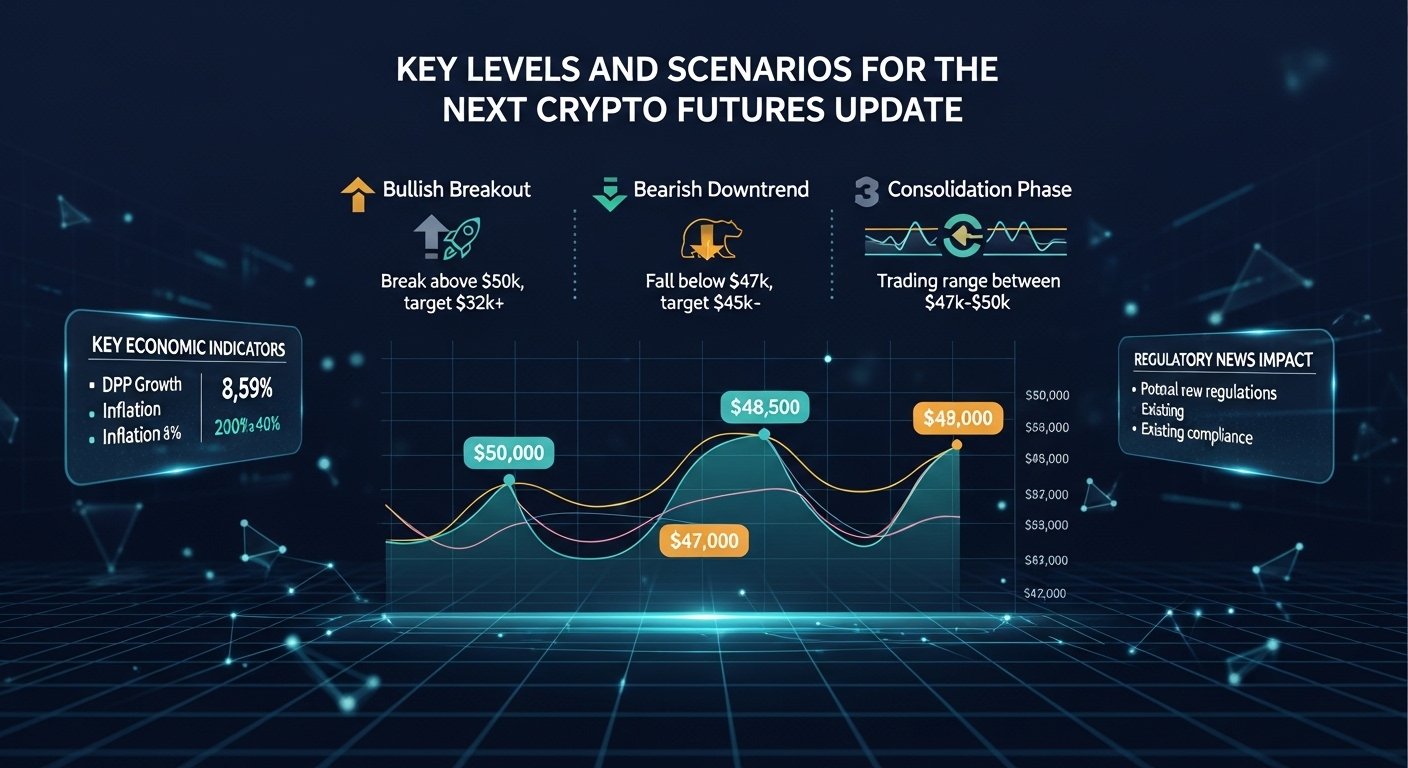
A reliable crypto futures update should end the guesswork by turning observations into scenarios. Scenarios help you avoid emotional decisions because they define what would change your mind. Instead of marrying a bias, you prepare for multiple outcomes and let the market confirm one.
Bitcoin breakout scenario: what confirmation looks like
In the bullish scenario for this crypto futures update, Bitcoin breaks the range high and holds above it. The confirmation is not just a wick above resistance. It’s acceptance. That often shows up as repeated closes above the level, shallow pullbacks that get bought, and a reduction in panic volatility after the initial push.
From a futures perspective, confirmation would ideally include funding that does not spiral out of control, and open interest that remains constructive rather than reckless. If funding spikes to extremes immediately, you may still get upside, but the risk of a trap increases. A calmer breakout tends to last longer.
Bitcoin rejection scenario: warning signs before a pullback
In the bearish or corrective scenario for this crypto futures update, Bitcoin fails to hold above the range high and slips back into the range. The most common warning signs include repeated rejections, rising funding paired with choppy price action, and a pattern where every push higher is met with quick selling.
If the rejection is leverage-driven, you may see a fast drop accompanied by long liquidations. That doesn’t automatically mean the trend is dead. Often, it simply resets positioning and creates a better base for a later attempt. The key is to distinguish a healthy reset from a structural breakdown. A pullback that holds above the range midpoint can be normal. A drop that slices through key support levels with expanding downside volatility is a different story.
Ether continuation scenario: the “quiet strength” becomes visible
For Ether, the bullish scenario in this crypto futures update is continuation of the steady grind, followed by an acceleration once the market recognizes the move. Often, Ether’s most explosive legs begin after a period of tight consolidation where traders become bored and under-positioned. Futures confirmation for Ether would include stable or only moderately positive funding and an orderly rise in open interest. If Ether begins to surge and funding spikes dramatically, the trade can still work—but it becomes more fragile, and risk management becomes more important.
Ether hesitation scenario: how strength can fade without drama
The bearish scenario for Ether in this crypto futures update is not always a dramatic crash. Sometimes it’s simply underperformance: Ether fails to push through resistance, drifts sideways, and then dips when Bitcoin pulls back. If Ether’s quiet strength is real, it should hold key higher lows and avoid sharp breakdowns on minor volatility spikes. If Ether starts to lose its relative strength versus Bitcoin at the same time that its funding becomes more crowded, it can suggest that the market’s positioning is getting ahead of itself.
How macro catalysts shape the crypto futures update
Even the best futures analysis exists inside a larger world. Macro conditions influence liquidity, risk appetite, and the probability that breakouts follow through. In this crypto futures update, the market’s sensitivity to macro headlines can show up as sudden volatility bursts that don’t seem “technical” at all. When liquidity is abundant and risk sentiment is positive, breakouts tend to follow through more often.
When liquidity is tight and traders are nervous, range highs become more likely to reject, and leveraged positions become more vulnerable. That’s why volatility, order flow, and the speed of reactions matter. The faster the market snaps and reverses, the more you should suspect leverage games rather than genuine accumulation. This doesn’t mean you need to predict macro news. It means you should respect that a futures-heavy market can shift quickly when catalysts hit. A smart crypto futures update builds flexibility into every plan.
