

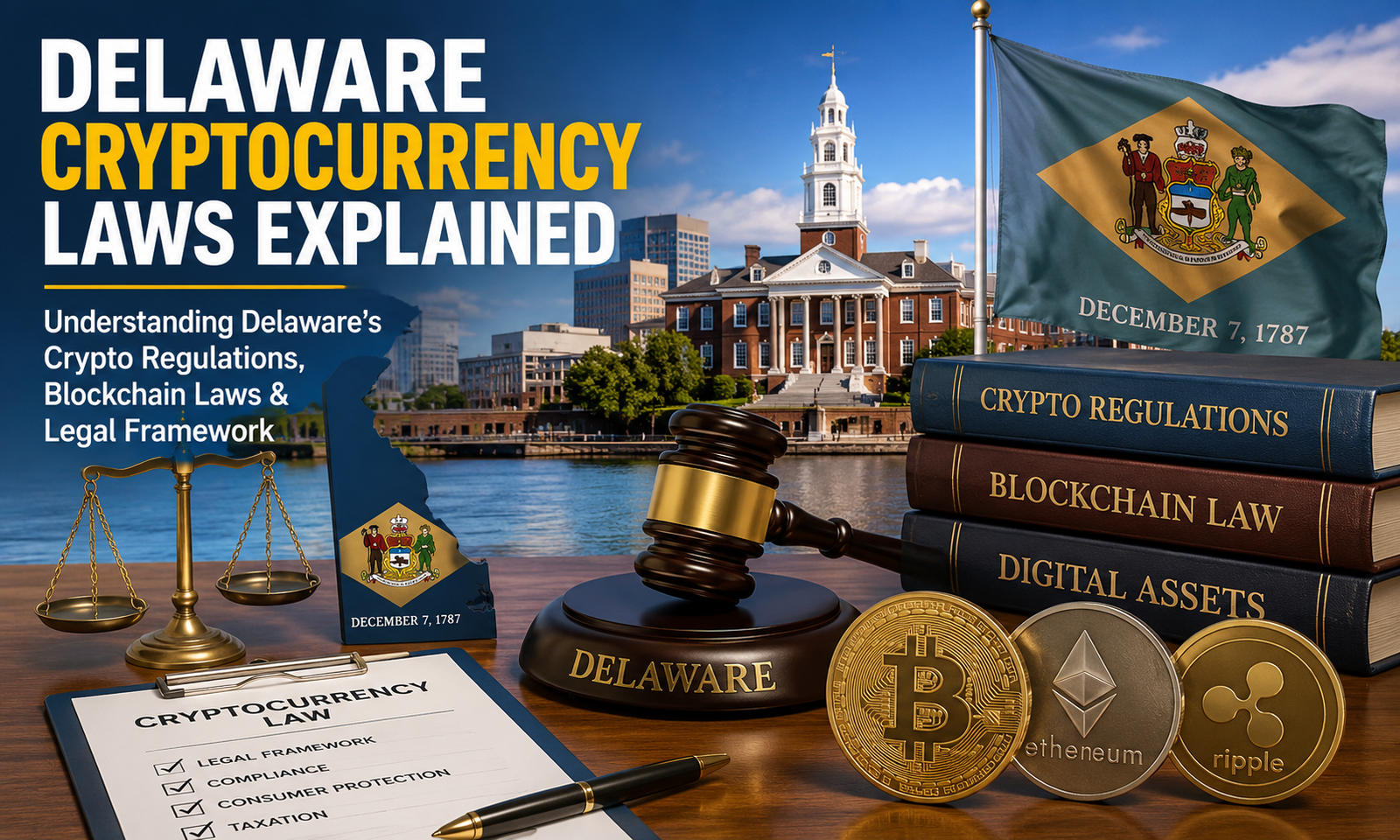
Cryptocurrency has rapidly transformed from a niche financial innovation into a global asset class used by millions of individuals, businesses, and institutional investors. As digital assets such as Bitcoin, Ethereum, and stablecoins continue gaining mainstream acceptance, U.S. states have adopted different approaches to regulating the cryptocurrency industry. Some states have introduced crypto-friendly legislation to attract blockchain companies, while others have tightened oversight to protect consumers and reduce financial risks.
One state that frequently appears in discussions about business law and corporate innovation is Delaware. Famous for being the legal home of more than one million companies, including many Fortune 500 corporations, Delaware has built a reputation for progressive business legislation. This naturally raises an important question: Does Delaware have cryptocurrency laws in place?
The answer is yes—but the state’s approach differs from jurisdictions that have enacted comprehensive cryptocurrency-specific regulations. Instead of creating an entirely separate legal framework, Delaware has integrated blockchain technology, digital assets, and virtual currency into existing corporate and commercial laws while complying with federal financial regulations. This balanced approach has made Delaware an attractive destination for blockchain startups, fintech firms, and digital asset companies.
In this guide, we’ll explore Delaware’s cryptocurrency laws, blockchain legislation, business licensing requirements, taxation, consumer protections, and what investors and companies should know before operating in the First State.
What Makes Delaware Important for Cryptocurrency Businesses?
Delaware has long been recognised as America’s corporate capital. More than two-thirds of Fortune 500 companies are incorporated there because of its business-friendly legal environment, predictable courts, and flexible corporate statutes.
This corporate reputation naturally extended into blockchain innovation. Rather than regulating cryptocurrencies aggressively, Delaware chose to modernise its legal infrastructure to accommodate blockchain technology, digital ledgers, and tokenized assets.
This distinction is important. Delaware is not attempting to replace federal cryptocurrency regulation. Instead, it provides a legal environment where blockchain businesses can incorporate, manage records, and develop innovative financial technologies with greater legal certainty.
Cryptocurrency Regulation in Delaware
Unlike states such as New York, which requires the famous BitLicense, Delaware has not introduced a comprehensive cryptocurrency licensing regime specifically for digital asset companies.
Instead, cryptocurrency businesses operating in Delaware typically comply with federal regulations while following applicable state financial and commercial laws. Businesses dealing with digital currencies, virtual assets, and crypto exchanges must still consider regulations involving:
- Money transmission
- Consumer protection
- Anti-money laundering compliance
- Securities regulations
- Corporate governance
Because cryptocurrency regulation remains heavily influenced by federal agencies, Delaware businesses often interact with guidance issued by FinCEN, the SEC, the CFTC, and the IRS.
Delaware’s Historic Blockchain Legislation
The Delaware Blockchain Initiative
One of Delaware’s most influential contributions to blockchain technology began in 2016 when state officials launched the Delaware Blockchain Initiative. The goal was not to regulate cryptocurrencies directly but to explore how blockchain could improve corporate governance, government recordkeeping, and business efficiency.
The initiative encouraged companies to use blockchain for:
- Corporate records
- Shareholder communications
- Digital ownership records
- Smart contracts
- Secure document storage
Although some early government projects evolved over time, the initiative demonstrated Delaware’s willingness to embrace blockchain innovation years before many other states.
Amendments to Delaware General Corporation Law
One of Delaware’s biggest legal milestones came when lawmakers amended the Delaware General Corporation Law (DGCL). These amendments allow corporations incorporated in Delaware to maintain shareholder records using blockchain technology.
This seemingly technical change carries significant implications. Traditional corporate records often rely on paper documentation or centralised databases. Blockchain technology allows these records to become:
Immutable
Transparent
Tamper-resistant
Digitally verifiable
These legal changes opened the door for tokenized securities, digital shareholder registers, and blockchain-based corporate governance.
Does Delaware Recognise Cryptocurrency as Legal Tender?
The simple answer is no.
Like every other U.S. state, Delaware does not recognise Bitcoin or any other cryptocurrency as legal tender.
Only the U.S. dollar remains legal tender under federal law.
However, businesses are generally free to accept cryptocurrency payments if both parties agree to the transaction.
Many Delaware companies voluntarily accept:
Bitcoin
Ethereum
USDC
Stablecoins
Other digital assets
These transactions operate as private contractual agreements rather than state-recognised legal tender.
Cryptocurrency Business Licensing in Delaware
One common misconception is that Delaware offers a special crypto business licence.
In reality, cryptocurrency companies usually register like other businesses while determining whether their activities qualify as money transmission under federal or state law.
Examples include:
Crypto Exchanges
Businesses facilitating cryptocurrency trading may require additional compliance depending on their services.
Crypto Payment Processors
Companies processing digital currency payments often review money transmitter obligations carefully.
Custody Providers
Businesses holding cryptocurrency on behalf of customers generally face stricter regulatory expectations.
Blockchain Software Companies
Software developers typically face fewer licensing obligations if they merely provide technology rather than financial services.
Delaware and Money Transmission Laws
Money transmission laws are among the most important legal considerations for cryptocurrency businesses. If a company transfers money or digital assets between customers, regulators may classify it as a money transmitter.
Whether a cryptocurrency business requires licensing depends heavily on its business model.
For example:
Providing wallet software alone differs significantly from operating a custodial exchange.
Facilitating peer-to-peer software differs from controlling customer assets.
Because these distinctions can be legally complex, many Delaware crypto companies seek specialised legal advice before launching services.
How Delaware Treats Blockchain Technology
Delaware views blockchain primarily as an innovative business technology rather than merely a cryptocurrency tool.
Blockchain applications extend well beyond digital currencies.
Examples include:
Corporate Recordkeeping
Businesses may securely store shareholder information using distributed ledger technology.
Smart Contracts
Companies increasingly automate commercial agreements through blockchain-enabled smart contracts.
Supply Chain Tracking
Blockchain helps businesses verify product authenticity and improve logistics.
Identity Verification
Secure digital identity systems continue emerging across multiple industries.
This broader perspective has strengthened Delaware’s reputation as a blockchain-friendly jurisdiction.
Cryptocurrency Taxation in Delaware
Many investors wonder whether Delaware imposes special cryptocurrency taxes.
The answer is no.
Instead, cryptocurrency taxation generally follows federal IRS guidance.
If residents buy, sell, trade, or earn cryptocurrency, they may incur taxable events under federal law.
Common taxable situations include:
Selling Cryptocurrency
Selling Bitcoin or another digital asset for profit may generate capital gains tax.
Trading Crypto
Exchanging one cryptocurrency for another may also trigger taxation.
Mining Rewards
Mining income is generally taxable.
Staking Rewards
Many staking rewards are treated as taxable income upon receipt.
Delaware residents should maintain accurate transaction records for tax reporting purposes.
Consumer Protection and Cryptocurrency
Like other states, Delaware seeks to protect consumers from fraud and financial misconduct.
State authorities may investigate businesses involved in:
Fraudulent investment schemes
False advertising
Ponzi schemes
Misleading token offerings
Identity theft
Scam exchanges
Consumers should always verify whether a cryptocurrency company has a legitimate business presence and appropriate regulatory compliance before investing.
Securities Laws and Digital Assets
One of the most complicated legal questions involves determining whether a cryptocurrency qualifies as a security.
Delaware follows federal securities law in this area. If a digital asset meets the definition of an investment contract under federal law, companies issuing or selling those tokens may need to comply with securities regulations.
Examples include:
Security token offerings
Investment contracts
Tokenized equity
Digital investment funds
Failure to comply with securities laws can result in substantial legal penalties.
Delaware’s Role in Tokenized Assets
Tokenization has become one of blockchain’s fastest-growing sectors.
Tokenized assets represent ownership interests in real-world assets using blockchain technology.
Examples include:
Real estate
Private equity
Stocks
Corporate shares
Investment funds
Because Delaware corporate law already supports blockchain-based shareholder records, many experts believe the state is well positioned to support continued tokenization growth.
How Delaware Compares With Other Crypto-Friendly States
Delaware’s approach differs significantly from several other states. Wyoming has enacted extensive cryptocurrency legislation covering digital asset ownership, decentralised autonomous organisations (DAOs), and special banking institutions.
Texas has become attractive for Bitcoin mining due to its energy infrastructure. Florida has promoted blockchain innovation through various initiatives. New York maintains one of the strictest regulatory systems with its BitLicense programme. Delaware instead focuses primarily on creating a reliable legal foundation for corporations while allowing blockchain innovation to flourish within existing commercial laws.
Why Many Blockchain Startups Choose Delaware
Despite not having the most aggressive cryptocurrency legislation, Delaware remains a preferred location for incorporation. Several advantages explain this popularity.
Business-Friendly Corporate Law
Delaware’s corporate statutes are among the most respected in the world.
Predictable Court System
The Delaware Court of Chancery provides specialised expertise in corporate disputes.
Investor Confidence
Many venture capital firms prefer Delaware corporations.
Flexible Governance
Corporate structures can adapt efficiently to innovative blockchain business models.
These factors often outweigh the absence of crypto-specific legislation.
Future Outlook for Delaware Cryptocurrency Laws
The cryptocurrency industry continues evolving rapidly. Institutional adoption, stablecoins, tokenized securities, decentralised finance, and blockchain infrastructure are expanding across financial markets.
Delaware will likely continue updating its corporate statutes to accommodate emerging technologies while relying on federal regulators for broader cryptocurrency oversight.
Potential future developments may include:
Greater recognition of tokenized securities
Expanded blockchain corporate governance
Improved digital identity frameworks
Modernised commercial transaction laws
Enhanced consumer protection standards
Rather than creating highly restrictive rules, Delaware appears committed to maintaining a flexible legal environment that supports responsible innovation.
Should Crypto Businesses Incorporate in Delaware?
For many blockchain companies, incorporating in Delaware remains an attractive option.
Businesses benefit from:
Strong corporate law
Well-established legal precedents
Investor familiarity
Blockchain-friendly governance rules
Flexible corporate structures
However, incorporation alone does not eliminate the need to comply with federal cryptocurrency regulations or the laws of states where customers reside. Legal compliance remains essential regardless of where a company is incorporated.
Conclusion
So, does Delaware have cryptocurrency laws in place? The answer is yes—but with an important distinction. Rather than introducing an extensive standalone cryptocurrency code, Delaware has chosen to modernise its corporate and commercial laws to accommodate blockchain technology, digital assets, and innovative financial applications. Through amendments to its corporate statutes and early support for distributed ledger technology, the state has established itself as a leader in blockchain-enabled business governance.
While Delaware does not recognise cryptocurrency as legal tender or operate a dedicated crypto licensing regime like some states, it offers a stable legal environment that attracts blockchain startups, fintech firms, and investors. Businesses must still comply with federal regulations concerning money transmission, securities, taxation, and anti-money laundering requirements, but Delaware’s flexible corporate framework provides a strong foundation for long-term growth.
As blockchain technology continues evolving, Delaware is expected to remain one of the most influential jurisdictions for corporate innovation, making it a compelling choice for companies seeking legal certainty while participating in the expanding digital asset economy.
