

XRP Slips 3% Despite once again finds itself at the center of a familiar crypto paradox. While Ripple continues to strengthen its regulatory position with fresh license approvals in major financial jurisdictions, the price of XRP has moved in the opposite direction. The token slipped roughly 3%, puzzling investors who expected regulatory progress to translate into bullish momentum. Instead, broader market forces — led by Bitcoin’s dominance and renewed regulatory uncertainty in the United States — have taken control of short-term price action.
This divergence highlights a critical truth about cryptocurrency markets: fundamentals and price do not always move in sync. Ripple’s expanding compliance footprint reinforces its long-term ambitions in global payments, but XRP remains highly sensitive to macro sentiment, Bitcoin volatility, and political developments involving major industry players like Coinbase. Understanding why XRP slipped despite positive news requires zooming out beyond Ripple alone and examining the forces shaping the wider crypto market.
In this article, we explore why XRP declined, what Ripple’s license approvals actually mean, how Bitcoin continues to influence altcoins, and why Coinbase’s regulatory stance has added pressure across the market. By the end, readers will have a clearer picture of where XRP stands today and what could shape its next move.
Ripple license approvals strengthen fundamentals but not sentiment
Ripple’s recent regulatory wins are meaningful from a business and institutional perspective. Securing payment-related approvals in Europe and expanding regulated operations signal that Ripple is positioning itself as a compliant global payments provider rather than a speculative crypto startup. These approvals allow Ripple to legally offer electronic money services, improve cross-border payment infrastructure, and engage more directly with banks and financial institutions.
For XRP, this progress reinforces its association with real-world financial use cases. Ripple’s strategy has long centered on regulatory compliance, and each new license strengthens the argument that its ecosystem is built for long-term adoption rather than short-term hype. However, markets do not always reward these developments immediately.
Traders often distinguish between structural progress and tradable catalysts. License approvals improve Ripple’s foundation, but unless they are accompanied by immediate increases in transaction volume, new partnerships, or visible demand for XRP, the price reaction can be muted. In the current environment, macro pressures have outweighed Ripple’s positive headlines.
Why regulatory wins don’t always move XRP price
Crypto markets tend to favor momentum over milestones. While Ripple’s licensing achievements suggest future growth, they do not guarantee short-term inflows into XRP. Many investors view regulatory compliance as a long-term value driver rather than a trigger for immediate price appreciation.
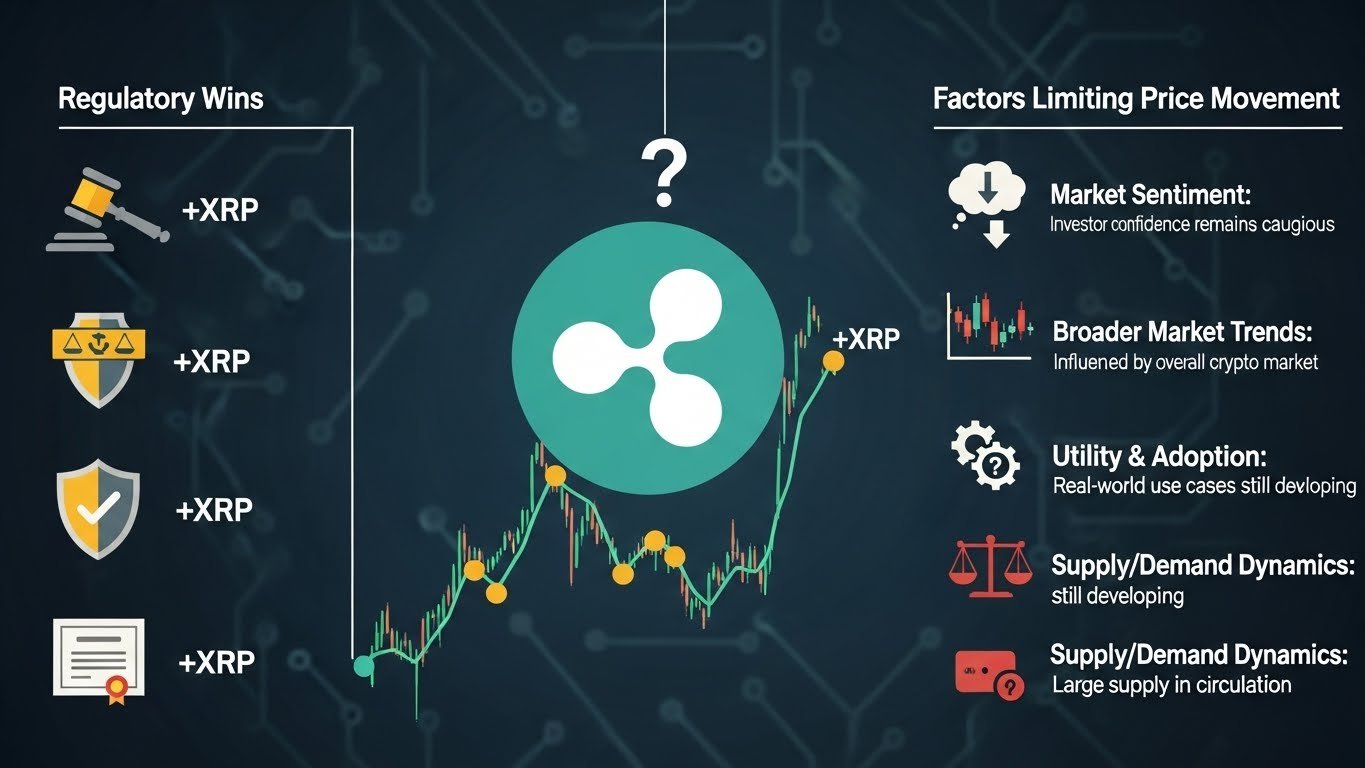
Additionally, XRP is one of the most liquid altcoins, which makes it a frequent target for profit-taking during periods of uncertainty. Even bullish news can become a selling opportunity if traders are already positioned or if broader market conditions appear fragile.
Bitcoin continues to set the market tone
The most important factor behind XRP’s 3% slip is Bitcoin’s influence. Bitcoin remains the dominant force in the crypto market, dictating overall sentiment, liquidity flows, and risk appetite. When Bitcoin struggles or trades cautiously, altcoins often follow regardless of their individual fundamentals.
At the time XRP declined, Bitcoin was showing signs of hesitation, leading traders to reduce exposure across the market. In such conditions, capital tends to consolidate into Bitcoin or move to the sidelines altogether. XRP, despite strong fundamentals, is not immune to this effect.
Bitcoin’s dominance creates a gravity that pulls altcoins into its orbit. Even assets with positive news can decline simply because the market is focused on preserving capital rather than seeking growth.
Correlation increases during uncertainty
During periods of regulatory or macroeconomic uncertainty, correlations between crypto assets increase. This means XRP trades less on its own narrative and more as part of a broader risk basket. When Bitcoin weakens or volatility rises, XRP often moves in tandem with the rest of the market.
This dynamic explains why XRP slipped despite Ripple’s progress. The market was not pricing individual success stories — it was pricing risk.
Coinbase policy uncertainty weighs on crypto sentiment
Adding to the pressure was renewed regulatory uncertainty stemming from Coinbase’s decision to pull support from a major U.S. crypto market structure proposal. This move raised concerns about the future of regulatory clarity in the United States, particularly regarding digital asset classification, tokenized securities, decentralized finance, and stablecoin incentives.
For the broader market, this development signaled that regulatory resolution may take longer than expected. Investors generally respond to such uncertainty by reducing exposure, especially to assets historically linked to regulatory scrutiny, such as XRP.
Even though Ripple has made significant progress outside the U.S., American regulatory sentiment still influences global crypto markets. When one of the industry’s largest exchanges expresses concern over proposed legislation, traders tend to reassess risk across the board.
Why policy headlines move markets faster than licenses
Legislative uncertainty impacts expectations immediately. Licensing progress, on the other hand, unfolds gradually. Markets react more strongly to perceived threats than to incremental improvements. As a result, Coinbase-related policy concerns overshadowed Ripple’s positive news in the short term.
This imbalance is not unusual in crypto. Regulatory fear often drives sharper price movements than regulatory progress.
XRP Slips 3% Despite caught between utility and speculation
XRP occupies a unique position in the crypto ecosystem. On one hand, it is tied to Ripple’s mission of enabling fast, low-cost cross-border payments. On the other, it trades like a high-liquidity speculative asset influenced by market cycles.
Ripple’s license approvals strengthen XRP’s utility narrative, reinforcing its role in a regulated financial future. However, XRP’s trading narrative remains dominant in the short term. As long as traders view XRP primarily as a vehicle for market exposure rather than a utility token in active use, its price will remain sensitive to external forces.
This dual identity explains much of XRP’s volatility. Long-term fundamentals may improve while short-term price action remains disconnected.
Institutional timelines differ from trader timelines
Institutions move slowly. They care about compliance, licensing, and operational certainty. Ripple’s progress appeals to this audience, but institutional adoption unfolds over months or years.
Retail traders and short-term investors, by contrast, respond to daily price movements and sentiment shifts. When Bitcoin hesitates or regulatory headlines turn negative, these participants often sell first and ask questions later.
What could drive XRP next
Looking ahead, XRP’s trajectory will depend on several key factors. Bitcoin’s ability to stabilize or resume an uptrend will play a major role. A strong Bitcoin environment typically allows altcoins to recover and outperform.
Additionally, Ripple’s next steps matter. If license approvals translate into measurable increases in payment volume, new partnerships, or expanded corridors, the market may begin to price in those benefits more aggressively.
Regulatory clarity — or at least reduced uncertainty — in the United States would also help restore confidence. Until then, XRP may continue to experience volatility even amid positive developments.
The balance between patience and positioning
For long-term investors, Ripple’s regulatory progress reinforces confidence in its strategy. For short-term traders, however, timing remains everything. Understanding which forces dominate at any given moment is crucial to navigating XRP’s price action.
Conclusion
XRP’s 3% decline despite Ripple securing important license approvals is not a contradiction — it is a reflection of how crypto markets function. Ripple is strengthening its regulatory foundation and positioning itself for long-term growth, but XRP’s short-term price remains governed by Bitcoin’s influence and shifting regulatory sentiment.
Coinbase’s policy concerns added another layer of uncertainty, reminding investors that regulatory clarity is still evolving. In this environment, markets prioritize caution over optimism.
For XRP holders, the key takeaway is perspective. Ripple’s progress matters most over the long term, while XRP’s daily movements are shaped by broader market forces. Recognizing this distinction can help investors make more informed decisions in an increasingly complex crypto landscape.
FAQs
Q: Why did XRP drop even after positive Ripple news?
XRP declined because broader market sentiment, driven by Bitcoin and regulatory uncertainty, outweighed Ripple’s positive licensing developments.
Q: Do Ripple license approvals benefit XRP long term?
Yes. Regulatory approvals strengthen Ripple’s business model and credibility, which can support XRP adoption over time, though not always immediately.
Q: How much does Bitcoin affect XRP?
Bitcoin heavily influences XRP and other altcoins. When Bitcoin weakens or becomes volatile, altcoins often decline regardless of individual news.
Q: Why does Coinbase policy news matter for XRP?
Coinbase’s stance affects overall regulatory sentiment. Increased uncertainty in the U.S. market can pressure XRP due to its historical regulatory exposure.
Q: Is XRP still a strong investment despite recent drops?
That depends on time horizon. Short-term volatility remains high, but Ripple’s regulatory progress supports a stronger long-term outlook for XRP.
