

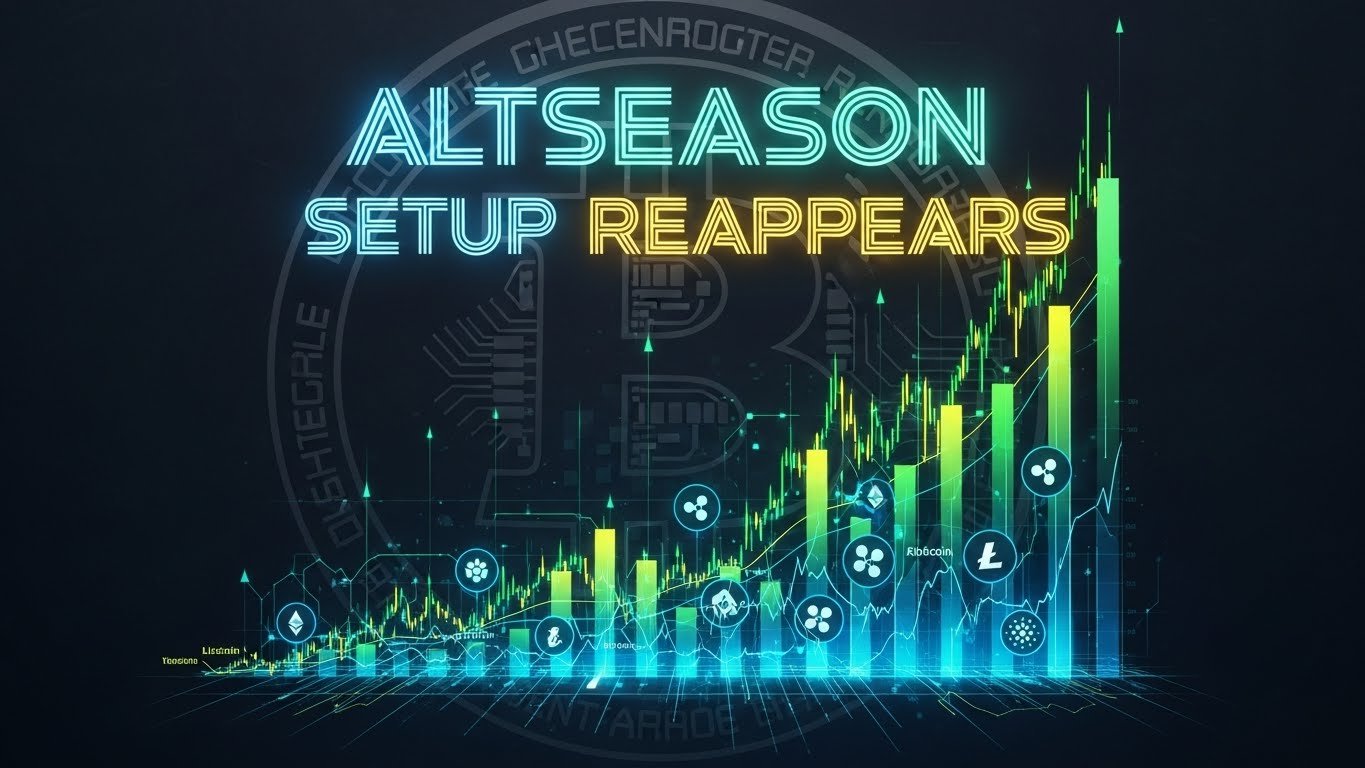
For months, the market has revolved around one main character: Bitcoin. As the oldest and most recognized cryptocurrency, it often leads the charge in every major cycle. But there comes a point in many bull markets when the spotlight shifts, volatility moves elsewhere, and traders begin chasing opportunities outside of BTC. That familiar pattern is emerging once again as an altseason setup reappears and capital begins shifting away from Bitcoin into higher-risk, higher-reward altcoins.
If you have been watching the charts, you may notice classic signs of this rotation. Bitcoin’s price starts to cool after a strong run. Bitcoin dominance stalls or trends down. At the same time, altcoin pairs begin breaking out, liquidity migrates toward Ethereum, large-cap altcoins, layer 1 chains, DeFi tokens and even meme coins, and social media buzz increasingly focuses on anything that is not BTC. This is how altseason typically announces itself.
The phrase “Altseason Setup Reappears as Capital Begins Shifting Away From Bitcoin” captures a familiar rhythm in crypto market structure. First, money piles into Bitcoin as the safe, liquid leader. Then, as confidence grows and traders become more comfortable with risk, capital rotates outward into the altcoin market, driving explosive moves in coins that had lagged for months. Understanding this rotation is crucial for anyone who wants to participate in upside while avoiding classic mistakes of chasing the very end of the trend.
In this in-depth guide, we will explore what altseason really means, why capital often leaves Bitcoin for altcoins, the key signals that an altseason setup is reappearing, and strategies that traders and investors can use to navigate this environment. We will also look at the risks, traps and emotional dynamics that can derail even the best plans when the market heats up.
Understanding Altseason and Capital Rotation
What is Altseason in Crypto?
Altseason is the period in the crypto market cycle when altcoins outperform Bitcoin for an extended stretch. Rather than BTC dominating gains, coins across sectors like layer 1 blockchains, DeFi, gaming, AI tokens and infrastructure projects experience stronger percentage moves. Traders often measure this shift by comparing altcoin indices to Bitcoin or by tracking how many altcoins are making new highs relative to BTC.
During a strong altseason, charts of Bitcoin may look flat or range-bound, while dozens of smaller coins post double or triple digit percentage gains. The narrative shifts from “Is Bitcoin breaking its resistance?” to “Which sector is next to pump?” Money becomes more adventurous, and the focus moves from store-of-value narratives to growth, innovation and speculation.
Crucially, altseason is not simply about random coins going up. It is a coordinated capital rotation where liquidity, trading volume and attention deliberately spread away from Bitcoin. This is why the phrase “Altseason Setup Reappears as Capital Begins Shifting Away From Bitcoin” is so powerful; it signals the stage at which the rotation is starting, not just when it is already in full swing.
Why Capital Flows Away From Bitcoin
Bitcoin is typically the first stop in a new bull cycle because it is perceived as relatively safer, more liquid and more institutionally accepted. Many large investors and funds enter via BTC before exploring more speculative opportunities. However, after a strong Bitcoin rally, new money slows down, and existing holders look for better risk-reward elsewhere.
This is where altcoins come in. When traders believe Bitcoin has less immediate upside or has entered a consolidation phase, they start reallocating into projects they believe can outperform. Capital begins shifting away from Bitcoin into coins with smaller market caps, higher volatility and stronger narrative potential.

Psychology also plays a big role. As portfolio values increase, people become more comfortable taking risk. Gains in Bitcoin create a cushion, and that cushion becomes the fuel for altcoin rotations. This cyclical behavior has occurred in several previous market cycles, which is why experienced traders pay close attention when they see an altseason setup reappear.
Signs the Altseason Setup is Reappearing
Declining Bitcoin Dominance
One of the clearest market-wide signals that capital is shifting away from Bitcoin is a drop in Bitcoin dominance, the percentage of the total crypto market capitalization that BTC represents. During early bull stages, Bitcoin dominance often rises as BTC absorbs the majority of inflows. Later, as altcoins wake up, dominance begins to roll over. When an altseason setup reappears, you often see Bitcoin’s price holding up reasonably well in dollar terms while its share of the total market shrinks.
This means other coins are growing faster than BTC. It does not always happen overnight. Sometimes dominance grinds down slowly as sector after sector of the altcoin market starts to rally. Traders who track this trend know that a sustained decline in dominance, combined with rising altcoin volumes, can confirm that the market is truly rotating rather than experiencing a short-lived, isolated pump.
Rising Liquidity and Risk Appetite in Altcoins
Another important sign that altseason is on the horizon is a surge in volume and liquidity across altcoin exchanges, decentralized exchanges and on-chain trading venues. When more participants actively trade altcoins, spreads tighten and price discovery becomes more efficient. This increased activity reflects growing confidence and a willingness to take on risk beyond Bitcoin.
In an environment where the altseason setup reappears, you may see Ethereum trading pairs gaining volume, DeFi tokens regaining momentum, and previously neglected coins suddenly attracting attention. Funding rates in derivatives markets can shift as traders open leveraged positions on altcoins rather than solely on BTC. This behavior suggests that the market is no longer content with the relative stability of Bitcoin. Instead, participants are hunting for asymmetric opportunities in coins that can move far more dramatically in both directions.
Altcoin Sectors Lighting Up in Waves
Altseason rarely hits every altcoin at the same time. It often unfolds in waves, with specific narratives leading the way. At one moment, layer 1 blockchains may dominate performance. Then, capital might rotate into DeFi protocols, followed by gaming and metaverse projects, and later into more speculative sectors like meme coins. When you see sector after sector start to outperform Bitcoin in rapid succession, it is a strong sign that the altseason setup has truly reappeared.
Traders chase the hottest narratives, and capital jumps from one pocket of the market to another, leaving a visible trail of explosive moves and rapid reversals. Recognizing this sector rotation is crucial. It allows market participants to understand that the pattern is not random; it is part of a broader capital rotation cycle where money systematically shifts away from Bitcoin to chase higher potential returns elsewhere.
How Capital Shifting From Bitcoin to Altcoins Usually Unfolds
Phase One: Bitcoin Leads the Charge
Most major crypto bull cycles start with a dominant Bitcoin uptrend. During this phase, BTC breaks through key resistance levels, attracts institutional attention, and enjoys strong narrative support as “digital gold” or a macro hedge. Altcoins often lag here, as risk-averse participants prefer the relative safety and established liquidity of Bitcoin.
In this stage, the headline is not yet “Altseason Setup Reappears as Capital Begins Shifting Away From Bitcoin.” Instead, the story is about Bitcoin’s strength. However, under the surface, smart money begins to accumulate select altcoins quietly, anticipating the eventual rotation.
Phase Two: Large-Cap Altcoins Wake Up
Once Bitcoin reaches a zone of consolidation or perceived fair value, traders start wondering where the next big move could come from. That is usually when large-cap altcoins such as Ethereum and a handful of top projects begin to outperform. Their charts start printing higher highs, and narratives around smart contracts, DeFi infrastructure and scalable networks gain traction.
At this point, capital begins shifting away from Bitcoin more visibly. Investors rotate part of their BTC profits into high-quality altcoins that still feel relatively safe compared to smaller, more speculative tokens. This is often the phase where altseason setup reappears on the radar of experienced traders who have seen this movie before.
Phase Three: Mid-Caps, Small-Caps and Speculation Surge
If the rotation continues and sentiment remains bullish, the market eventually enters a more aggressive phase. Mid-cap and small-cap coins start to explode upward as traders search for the next big outperformer. Narrative-driven tokens, newly launched projects, and even fundamentally weak coins can see huge, short-lived rallies as liquidity cascades through the ecosystem.
This is the stage in which the phrase “Altseason Setup Reappears as Capital Begins Shifting Away From Bitcoin” turns into a fully realized altseason. The majority of attention is now focused on altcoins. Bitcoin may still hold value, but it no longer leads the excitement. While this phase can be extremely profitable for timely participants, it is also the most dangerous. Latecomers often chase parabolic moves, buy local tops and then watch their positions draw down sharply when the cycle inevitably cools.
Strategies for Navigating a Renewed Altseason Setup
Building a Narrative-Based Thesis
When an altseason setup reappears, randomness and noise increase dramatically. It becomes critical to develop a clear thesis rather than simply chasing whatever is trending on social media. This might involve identifying a few core narratives, such as scalable layer 1s, real-yield DeFi protocols, cross-chain infrastructure or AI-related tokens, and focusing on projects within those themes.
By aligning your positions with narratives that have strong fundamentals and real adoption potential, you reduce the risk of being left with illiquid bags when hype fades. It also becomes easier to track whether your thesis is playing out, as you can follow metrics, partnerships and product updates tied to those specific sectors.
Practicing Strict Risk Management
Altseason is exciting precisely because altcoins can move faster than Bitcoin. But that speed cuts both ways. The same volatility that makes altcoins so attractive on the way up can inflict serious damage on the way down. Risk management in an environment where capital is shifting away from Bitcoin means setting clear position sizes, using stop levels or mental exit points, and avoiding overexposure to any single coin or narrative.
It also means being honest about your time horizon. If your thesis is short term, treating it like a long-term investment can be dangerous. Many seasoned participants take profits in stages, rotate some gains back into Bitcoin or stablecoins, and maintain a balance between aggressive and defensive positions. In this way, they participate in the upside of altseason without betting the entire portfolio on highly speculative plays.
Using On-Chain Data, Sentiment and Technicals
In a renewed altseason, relying on a single type of signal is risky. A more robust approach combines different forms of analysis. Price charts and technical structures can show you where support, resistance and trend strength lie. On-chain data can reveal whether active addresses, transaction volumes and liquidity are growing for a given project.
Sentiment tools can help you gauge whether a narrative is just starting to gain traction or already overhyped. When an Altseason Setup Reappears as Capital Begins Shifting Away From Bitcoin, these tools help you distinguish sustainable, early-stage rotations from late-stage euphoria. They also help you avoid getting trapped in coins that have already exhausted most of their upside.
Risks and Traps When Capital Leaves Bitcoin
Overexposure to Illiquid, High-Risk Altcoins
One of the biggest dangers of altseason is the temptation to abandon Bitcoin entirely in favor of tiny, illiquid projects promising huge returns. While some of these coins do indeed experience explosive rallies, many fail to sustain momentum or ever reclaim their highs once the cycle ends. When the altseason setup reappears, wise participants remember that liquidity is a shield. Larger, more established altcoins may not offer the same extreme upside as micro-caps, but they also provide stronger liquidity, deeper order books and more reliable exit opportunities. Balancing speculative bets with more liquid holdings can make the difference between a profit and a painful lesson.
Emotional Trading and Fear of Missing Out
Altseason amplifies emotions. As friends, influencers and anonymous accounts share eye-popping percentage gains, it becomes almost irresistible to chase whatever is currently pumping. This is where the fear of missing out, or FOMO, leads traders to abandon plans, ignore risk and buy at the worst possible moments.
Recognizing that the Altseason Setup Reappears as Capital Begins Shifting Away From Bitcoin does not mean every move must be captured is essential. It is better to ride a few well-chosen trends with discipline than to jump blindly into every rally. Emotional trading almost always ends in regret when the cycle turns.
Regulatory and Macro Surprises
Even in a powerful altseason, the broader environment still matters. Regulatory news, macroeconomic data and central bank decisions can shift sentiment dramatically. A series of negative headlines or a sudden risk-off move in traditional markets can drain liquidity from altcoins much faster than from Bitcoin.
Traders should remember that altcoins sit higher on the risk spectrum. When conditions deteriorate, capital often rushes back into Bitcoin or even into stablecoins. In other words, the same rotation that benefits altcoins can reverse violently, and understanding that risk is crucial to surviving beyond a single cycle.
Long-Term View: What an Altseason Means for Bitcoin
It might seem that an altseason is bad for Bitcoin because capital is temporarily shifting away from it. In reality, altseason can strengthen the broader ecosystem that ultimately supports BTC. As more users experiment with DeFi platforms, decentralized applications, NFTs and alternative blockchains, overall crypto adoption grows. Many of those new users still view Bitcoin as the foundational asset and eventually allocate part of their capital back into BTC for long-term holding.
From this perspective, an Altseason Setup Reappears as Capital Begins Shifting Away From Bitcoin not as a threat but as a cycle. Bitcoin often leads the first stage of a bull market, then altcoins expand the universe of use cases, and finally some of that value cycles back into BTC as traders de-risk. For long-term believers, this means that altseason is part of a natural rhythm rather than a permanent shift in power. Understanding how capital flows between Bitcoin and altcoins helps investors position themselves for multiple phases of the market rather than focusing on only one.
Conclusion
The phrase “Altseason Setup Reappears as Capital Begins Shifting Away From Bitcoin” captures a pivotal moment in the crypto market cycle. It signals that Bitcoin’s role as the primary engine of returns is easing and that liquidity, attention and speculation are migrating into the broader altcoin universe.
When this setup appears, experienced traders pay close attention to Bitcoin dominance, altcoin liquidity, sector rotations and narrative strength. They understand that altseason can offer extraordinary opportunities but that those opportunities come with elevated risk, faster moves and stronger emotional pressures.
Navigating this environment successfully requires more than excitement. It demands narrative-based theses, strict risk management, multi-dimensional analysis and an understanding of how capital rotates between Bitcoin and altcoins. It also requires humility, because no cycle lasts forever and no rally is guaranteed.
Altseason, when approached wisely, can be a period of growth, learning and profit. When approached recklessly, it can wipe out months or years of gains. As capital begins shifting away from Bitcoin once again, the challenge and the opportunity are the same: respect the cycle, manage your risk and let experience guide your decisions in the most volatile phase of the market.
FAQs
Q: What does “Altseason Setup Reappears as Capital Begins Shifting Away From Bitcoin” actually mean?
It means the market is entering a phase where altcoins begin to outperform Bitcoin. Capital that was previously concentrated in BTC starts rotating into altcoins, leading to stronger moves in the broader altcoin market. This setup often follows a strong Bitcoin rally and is characterized by declining Bitcoin dominance, rising altcoin volumes and increasing interest in non-BTC narratives.
Q: How can I tell if an altseason is really starting and not just a short altcoin pump?
A genuine altseason usually shows multiple signs at once: Bitcoin dominance trending down, sustained volume increases across many altcoins, sector-based rallies rather than isolated pumps and altcoin performance consistently outpacing Bitcoin over weeks rather than hours. When this pattern repeats and the rotation persists across different narratives, it is more likely that you are seeing a true altseason rather than a brief spike.
Q: Should I sell all my Bitcoin when altseason begins?
Completely abandoning Bitcoin is rarely wise. While capital does shift away from Bitcoin during altseason, BTC still acts as a key store of value and a more liquid asset in times of volatility. Many experienced participants keep a core Bitcoin position while allocating a portion of their portfolio to altcoins. This approach allows them to benefit from altseason while maintaining exposure to the asset that often leads and anchors the broader market cycle.
Q: Which types of altcoins tend to perform best when capital leaves Bitcoin?
Historically, large-cap altcoins such as major smart contract platforms and high-utility infrastructure projects often lead the first wave, followed by mid-cap and smaller, more speculative coins. Sectors like layer 1 blockchains, DeFi, gaming, AI-related tokens and other strong narratives can see outsized gains. However, performance varies each cycle, and no sector is guaranteed to lead. Research, narrative strength and adoption trends matter more than repeating exact patterns from previous markets.
Q: What is the biggest mistake traders make during altseason?
The most common mistake is chasing parabolic moves without a plan. Traders see huge percentage gains, buy late, ignore risk management and hold through drawdowns that erase most of their profits. Another common error is failing to rotate out of speculative coins once momentum fades. Successful navigation of altseason involves taking profits, managing position sizes and remembering that the cycle will eventually cool, even when sentiment feels euphoric.
Also More: Kusama KSM Price Prediction 2025 Analysis Expert Forecast and Market Outlook
