

Crypto market often feels like it moves on headlines, hype, and sentiment. But under the surface, the most useful clues about where price may be headed next frequently come from Bitcoin Derivatives Warn. Futures, perpetual swaps, and options collectively form a real-time stress test for market positioning. When traders are confident, leverage tends to build, open interest climbs, and liquidations remain relatively contained. When uncertainty rises, the derivatives complex begins to behave differently—open interest starts to fall, liquidations spike, and funding and volatility metrics shift as traders scramble to reduce risk.
Right now, those caution signals are becoming harder to ignore. A slipping open interest figure suggests leverage is coming off the table, either voluntarily through de-risking or involuntarily through forced unwinds. At the same time, rising liquidations imply that traders are being pushed out of positions faster than they can adjust. This combination matters because Bitcoin derivatives don’t just reflect sentiment; they can actively amplify price swings. Liquidations create market orders, market orders move price, and price movement triggers more liquidations. That reflexive feedback loop is how relatively modest moves in spot price can turn into sudden cascades.
Still, a drop in open interest is not automatically bearish, and higher liquidations don’t guarantee a crash. Sometimes these signals mark a “leverage reset” that clears the market of crowded positions, paving the way for healthier price discovery. The key is context: where open interest is falling, which side is getting liquidated, how funding is behaving, what options traders are pricing in, and whether spot markets confirm the risk-off tone.
In this article, we’ll break down what it means when Bitcoin derivatives flash caution as open interest slips and liquidations rise. You’ll learn how these indicators work, why they matter, and how traders and long-term investors can interpret them without getting whipsawed by noise.
What Bitcoin Derivatives Measure That Spot Markets Can’t
Spot markets show the last traded price of Bitcoin and the volume that changes hands. That’s important, but it doesn’t capture leverage, positioning pressure, or the potential energy stored in the market. Bitcoin derivatives do. They reveal how traders are expressing directional views with borrowed exposure, how crowded one side of the trade has become, and how fragile the market is if price nudges into liquidation territory.
A major advantage of Bitcoin derivatives is that they offer a window into risk appetite. When traders feel bold, they pile into futures and perpetual swaps, pushing open interest higher. When they feel defensive, they close positions, open interest declines, and the market becomes less “levered.” That sounds stabilizing, but the transition from high leverage to low leverage can be violent because it often happens during fast price moves—exactly when liquidations rise.
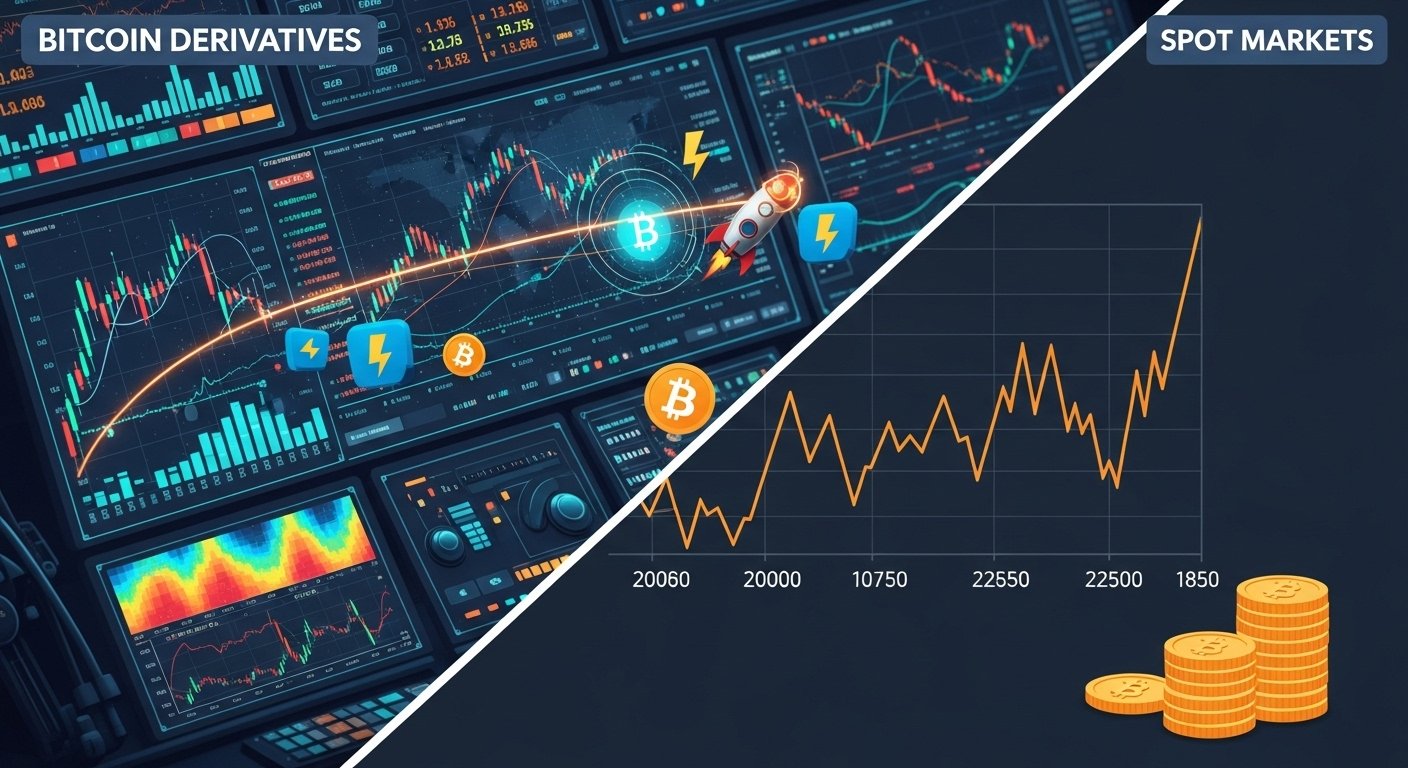
Options provide another layer. They show not only direction but expectations about magnitude. When the options market prices higher implied volatility, it’s a clue that traders expect larger swings ahead. Together, futures, perps, and options form a toolkit for reading the market’s internal tension—something spot alone simply can’t show.
Futures vs Perpetual Swaps: Where the Liquidations Often Start
In Bitcoin derivatives, perpetual swaps are among the most popular instruments because they mimic spot exposure without expiry. Their built-in funding mechanism pushes the perp price toward spot by charging one side of the trade to pay the other. When the market is aggressively long, funding tends to be positive, meaning longs pay shorts. When the market leans short, funding often flips negative.
Perps are also where liquidation cascades most commonly erupt. Because many traders use high leverage in perpetual swaps, a swift move against the crowd can trigger forced closures. Those forced closures turn into immediate buy or sell pressure, which can snowball into a broader unwind across the entire derivatives complex.
Futures, especially those with expiry, can be more institutionally oriented. But in stress events, futures markets can also see sharp position reductions as traders rush to cut exposure. When open interest falls across both perps and futures, the message from Bitcoin derivatives is loud: leverage is being pulled back.
Options Markets: The “Insurance Pricing” of Crypto
Options are the insurance market of Bitcoin. If implied volatility rises, it can signal that traders are willing to pay more for protection—or that market makers demand a higher premium to take the other side. In periods when open interest is slipping and liquidations are rising, options often reprice quickly because the probability of big intraday moves increases.
In Bitcoin derivatives, options data like implied volatility, skew, and put-call dynamics help explain whether fear is one-sided or balanced. If puts become notably more expensive relative to calls, it can point to demand for downside protection. If calls are bid, traders may be positioning for a sharp rebound after leverage is flushed out. Either way, options provide critical context for interpreting caution signals.
Open Interest Explained: Why a Drop Can Be a Red Flag—or a Reset
Open interest is the total number of outstanding contracts in futures and perpetual swaps. Think of it as the “amount of active leverage” sitting in the system. When open interest climbs, more positions are being opened than closed, and the market’s leverage footprint expands. When open interest falls, positions are being reduced and exposure is shrinking.
In Bitcoin derivatives, open interest doesn’t tell you direction by itself. Open interest can rise in a rally as longs pile in, but it can also rise in a selloff if shorts aggressively build positions. What matters is how open interest changes relative to price action and liquidations.
If price drops and open interest drops at the same time, that often indicates longs are exiting and leverage is being flushed. If price rises while open interest drops, it can suggest shorts are closing, powering a squeeze. If price moves sideways and open interest falls, it may be a sign of traders stepping back and reducing risk, which can reduce liquidity and make the next move sharper.
Interpreting Open Interest with Price: The “Positioning Story”
When Bitcoin derivatives show slipping open interest, the first question is: who is unwinding? If liquidations are rising during the open interest decline, that’s a hint the unwind isn’t entirely voluntary. Forced liquidations typically accelerate open interest reductions because positions are closed automatically.
A cautious interpretation emerges when open interest falls during choppy trading. That can mean traders are uncertain and unwilling to hold leveraged bets overnight. It can also mean market makers are reducing exposure, potentially thinning liquidity. Thinner liquidity can exaggerate price moves, which in turn increases liquidation risk. That’s how a market can feel calm one moment and violent the next.
Why Open Interest Falling Can Sometimes Be Constructive
Not all open interest declines are negative. In fact, a leverage reset can be healthy. When Bitcoin derivatives become too crowded on one side—usually the long side during euphoric phases—a flush of positions can clear the air. That reduces the risk of a massive cascade later and can allow spot demand to reassert itself.
The key difference between a constructive reset and a fragile breakdown is whether the market stabilizes after the unwind. If liquidations spike, open interest drops, and then funding normalizes while price holds key levels, the reset may be doing its job. If liquidations keep rising and open interest keeps falling while volatility expands, the caution signal remains active.
Liquidations Rising: What It Says About Leverage and Market Fragility
Liquidations occur when a leveraged position no longer meets margin requirements and is forcibly closed by the exchange. In Bitcoin derivatives, liquidation data is like a stress alarm. Rising liquidations mean more traders are being forced out, which implies that positions were too leveraged for the current volatility.
What makes liquidations especially important is their mechanical impact on price. A long liquidation typically sells into the market, pushing price down. A short liquidation buys into the market, pushing price up. When liquidations rise sharply, they can become a dominant driver of intraday movement.
Long vs Short Liquidations: The Directional Clue
Not all liquidation spikes are equal. If Bitcoin derivatives show predominantly long liquidations, it suggests the market was overextended to the upside and is now being punished by a downside move. That often aligns with risk-off behavior and can accelerate a drop as stop-outs cluster.
If short liquidations dominate, it can signal a squeeze, especially if price is climbing while open interest declines. In that case, the caution signal is less about imminent downside and more about heightened volatility. Squeezes can be followed by reversals, particularly if the move is mostly mechanically driven rather than supported by spot demand.
Liquidation Cascades: How One Move Turns Into a Wave
The most dangerous scenario in Bitcoin derivatives is a liquidation cascade. It begins when price hits a level where many positions have similar liquidation thresholds. As those positions are closed, market orders hit the book, pushing price further, which triggers the next layer of liquidations.
This is why traders pay close attention to leverage concentrations, funding extremes, and rapid open interest build-ups. A market can look stable on the surface while quietly accumulating the conditions for a cascade. When open interest is slipping and liquidations are rising, the market may already be in the middle of that deleveraging cycle.
Key Derivatives Indicators to Watch When Caution Signals Flash
When Bitcoin derivatives look shaky, single metrics can mislead. The best approach is to read a cluster of signals together, because they tell a more complete story about positioning, stress, and the probability of follow-through moves.
Funding Rates: The Temperature Gauge of Perpetual Swaps
Funding rates show which side is paying to hold exposure. Persistently high positive funding suggests crowded longs, while deeply negative funding suggests crowded shorts. When open interest is slipping, funding often changes quickly because positions are getting closed and imbalance is correcting.
If Bitcoin derivatives show liquidations rising while funding remains stubbornly extreme, that can be a sign the flush isn’t done yet. If funding normalizes after a liquidation spike, it can indicate that the market has partially reset.
Basis and Contango/Backwardation: Institutional Positioning Signals
The basis is the premium (or discount) of futures relative to spot. In calmer conditions, futures often trade at a premium, a structure called contango, reflecting financing costs and demand for leveraged exposure. In stress, that premium can compress or flip negative into backwardation, implying urgency to hedge or exit.
A falling basis alongside slipping open interest can strengthen the caution message from Bitcoin derivatives, especially if it suggests that larger participants are reducing risk.
Implied Volatility and Skew: What Options Traders Expect Next
Options implied volatility tends to rise when markets fear large moves. Skew shows whether downside puts are becoming more expensive than upside calls. In a cautionary derivatives regime, implied volatility often jumps, and skew can tilt bearish if traders aggressively seek protection.
If Bitcoin derivatives show open interest declining while implied volatility climbs, it can mean traders are shifting from leveraged directional bets to hedged, option-based exposure. That is classic risk-off behavior.
Why These Signals Often Appear Before Major Price Swings
Spot markets can drift for days with limited clues about hidden leverage. But Bitcoin derivatives can reveal mounting pressure earlier. Open interest build-ups often precede sharp moves because they represent stored directional exposure. When that exposure becomes unstable, price doesn’t need a huge catalyst to move—it just needs a push.
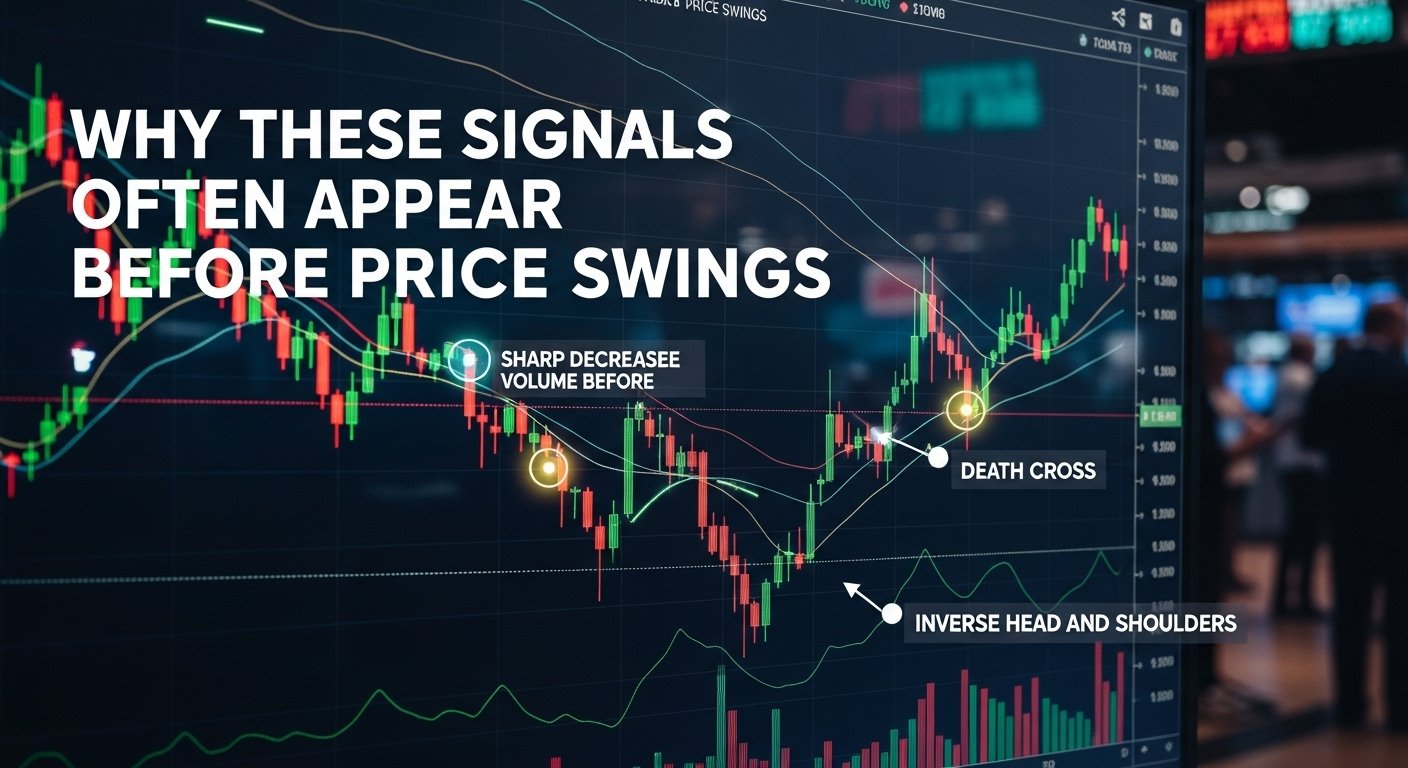
Slipping open interest and rising liquidations are the signatures of that instability being resolved in real time. The market is actively shedding leverage. Sometimes this process ends quickly with a sharp wick and a rebound. Other times it evolves into a longer de-risking phase where rallies get sold and volatility remains elevated.
One reason these signals matter is that liquidation-driven markets can overshoot. That means price can move further than fundamentals justify in the short run. Traders watching Bitcoin derivatives aim to recognize when a move is powered by forced flows rather than organic buying or selling, because forced flows can end abruptly once the leverage is cleared.
Risk Management in a Derivatives-Driven Market
When Bitcoin derivatives are flashing caution, the primary goal for traders is survival. Volatility can expand faster than expected, and leverage that felt “safe” yesterday can become dangerous today. The difference between a manageable drawdown and a wipeout often comes down to position sizing, margin discipline, and avoiding crowded trades at the wrong moment.
For investors who aren’t trading leverage, derivatives signals still matter because they influence spot price behavior. A derivatives-led flush can create sudden discounts or spike fear temporarily. Long-term participants can benefit from understanding when markets are being driven by forced liquidations rather than lasting shifts in fundamentals.
In a deleveraging phase, patience often outperforms prediction. If open interest is still falling and liquidations remain elevated, the market may not have found a stable footing yet. When the data begins to show liquidations cooling, funding normalizing, and price stabilizing, the caution signal from Bitcoin derivatives may be fading.
Conclusion
When Bitcoin derivatives flash caution signals—open interest slips and liquidations rise—the market is telling you something important: leverage is being unwound, and volatility risk is elevated. This doesn’t automatically mean a prolonged bear move is inevitable, but it does mean the market’s internal structure is unstable enough to produce sharp swings.
The smartest takeaway is not fear, but clarity. Slipping open interest often points to de-risking and shrinking exposure. Rising liquidations suggest forced flows are in play, increasing the chance of sudden cascades. Funding rates, basis, and options volatility add critical context that helps distinguish a healthy reset from a deeper breakdown.
If you trade, treat these conditions as a moment to tighten risk management and avoid emotional entries. If you invest, view derivatives stress as a lens for understanding short-term turbulence rather than a reason to abandon long-term conviction. In the end, Bitcoin derivatives are the market’s nervous system—when they twitch, it pays to pay attention.
FAQs
Q: What does it mean when open interest drops in Bitcoin derivatives?
A drop in open interest in Bitcoin derivatives means there are fewer outstanding leveraged contracts, typically because traders are closing positions. Depending on price action, it can signal de-risking, a leverage reset, or forced unwinds from liquidations.
Q: Are rising liquidations always bearish for Bitcoin?
Rising liquidations in Bitcoin derivatives are not always bearish, but they do signal stress and higher volatility. If long liquidations dominate, downside pressure can increase. If short liquidations dominate, it can fuel a squeeze upward, sometimes followed by a reversal.
Q: How do funding rates help interpret derivatives caution signals?
Funding rates in Bitcoin derivatives show whether longs or shorts are paying to hold positions. Extreme funding alongside rising liquidations can suggest the market is still crowded and vulnerable. Normalizing funding after a liquidation spike can indicate a healthier balance.
Q: Why do liquidation cascades happen so quickly?
Liquidation cascades in Bitcoin derivatives happen quickly because forced closures become market orders that move price, triggering more liquidations at nearby thresholds. This reflexive loop can accelerate price moves far beyond what spot demand alone would produce.
Q: How can long-term investors use derivatives data without trading leverage?
Long-term investors can watch Bitcoin derivatives to understand whether price is being driven by forced leverage unwinds. When open interest falls and liquidations rise, volatility may be mechanical and temporary, helping investors contextualize sharp dips or spikes without overreacting.
Also More: Bitcoin Near $90K as Gold Sets Records
