


Bitcoin DeFi Access has been the most widely recognized digital asset, yet it has often been treated primarily as a store of value rather than an asset that can be deployed productively. Institutions—asset managers, hedge funds, market makers, banks, and corporate treasuries—have largely participated through spot exposure, futures, ETFs, and custody solutions designed to minimize operational risk. Meanwhile, decentralized finance has evolved rapidly elsewhere, offering lending, borrowing, trading, and yield strategies that resemble capital markets infrastructure—just without traditional intermediaries.
The missing bridge has been clear: institutions demand regulated-grade custody, robust governance controls, auditability, and clear compliance workflows. At the same time, Bitcoin-native DeFi needs smart contract functionality that respects Bitcoin’s security model while enabling programmable applications. This is exactly the gap that the combined story of Fireblocks and Stacks speaks to. When Fireblocks and Stacks bring institutional access to Bitcoin DeFi, it signals that Bitcoin is no longer limited to passive exposure. Instead, it can become a working asset in secure, compliant, and scalable ways—without asking institutions to compromise on the safeguards they require.
The significance goes beyond a single integration narrative. It reflects a broader shift: institutions are looking for yield and utility on BTC, but they want it delivered through familiar operational controls. Stacks, as a Bitcoin-aligned smart contract layer, makes it possible to build applications that feel like DeFi while anchoring security and settlement logic to Bitcoin.
Fireblocks, known for institutional-grade digital asset infrastructure, provides the policy controls, custody workflows, and secure transaction execution that firms need to participate responsibly. Put together, Fireblocks and Stacks bring institutional access to Bitcoin DeFi in a way that feels less like experimentation and more like infrastructure. In this article, we’ll unpack what this shift means, how the pieces fit together, what “institutional” truly requires, and how Bitcoin DeFi can evolve from a niche narrative into a durable financial category.
The Institutional Problem: Bitcoin Exposure Without Bitcoin Utility
Institutional Bitcoin exposure has grown, but it has often been constrained by a simple tradeoff: either hold BTC securely and do very little with it, or chase yield and accept operational and counterparty risks that don’t meet institutional standards. In traditional markets, capital doesn’t sit idle. It is lent, hedged, collateralized, and routed through systems built for risk management. Institutions want the same capability with BTC, especially as Bitcoin becomes a core macro asset in some portfolios.
However, institutional participation is never just about the opportunity. It’s about whether a strategy fits into existing governance frameworks. Risk committees want clarity on custody, transaction approval, segregation of duties, audit logs, and exposure limits. Compliance teams need to know how counterparties are screened, how sanctions controls are applied, and how reporting is generated. Operations teams need reliability, predictable settlement, and workflows that don’t depend on manual processes.
This is why the phrase Fireblocks and Stacks bring institutional access to Bitcoin DeFi resonates. It implies that Bitcoin DeFi is moving closer to the operational reality institutions require. The goal isn’t “more DeFi.” The goal is Bitcoin DeFi that can survive real scrutiny, real volumes, and real risk management expectations.
What Is Bitcoin DeFi, Really? Moving Beyond the Buzzword
“Bitcoin DeFi” can mean several things, and the differences matter when discussing institutions. At a high level, Bitcoin DeFi refers to decentralized financial applications that allow BTC holders to do more than hold or trade. It includes borrowing and lending markets, decentralized exchanges, collateralized stable assets, yield strategies, and structured products. The complexity comes from the fact that Bitcoin’s base layer is intentionally conservative. It prioritizes security and decentralization over expressive smart contract functionality.
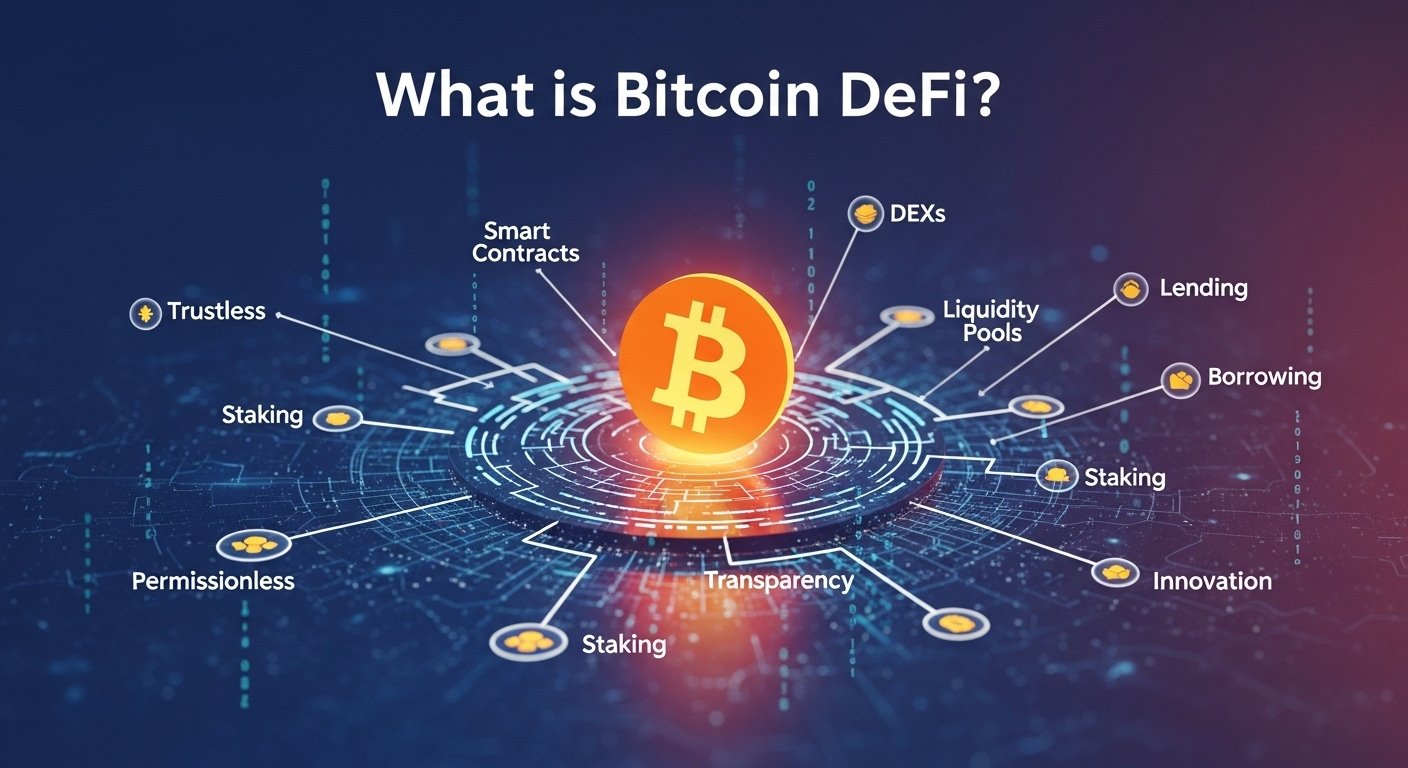
That’s where Bitcoin-adjacent layers and protocols enter the story. They provide programmable environments while preserving a relationship to Bitcoin’s security and settlement. Stacks, in particular, has emphasized a model where smart contracts can be created in a way that is meaningfully aligned with Bitcoin, supporting the thesis that Bitcoin liquidity can be activated without abandoning the principles that made Bitcoin valuable in the first place.
For institutions, clarity is everything. They need to understand where settlement occurs, what chain risk exists, how bridges work (if any), and what the failure modes might be. The maturation of Bitcoin DeFi depends on delivering these answers in a way that can satisfy institutional due diligence—precisely why the narrative that Fireblocks and Stacks bring institutional access to Bitcoin DeFi is gaining traction.
Why Stacks Changes the Bitcoin DeFi Equation
Stacks is often discussed as a smart contract layer that expands what’s possible in a Bitcoin-aligned ecosystem. What makes Stacks particularly relevant to Bitcoin DeFi is that it enables applications to be built with programmability while remaining anchored to the broader Bitcoin narrative. For institutions, that alignment is not just philosophical—it’s practical. Many firms are comfortable with Bitcoin’s longevity, security reputation, and deep liquidity. A Bitcoin-centric DeFi environment that respects those foundations is more likely to pass internal review than a strategy that requires moving BTC into unfamiliar ecosystems with unclear risk boundaries.
How Programmability Unlocks Institutional-Grade Use Cases
Institutions don’t just want yield. They want repeatable strategies that can be modeled, stress-tested, and governed. Programmable smart contracts make it possible to create lending markets with transparent collateral rules, automated liquidation logic, interest rate models, and verifiable state changes. They also enable on-chain market structures that can resemble capital markets primitives, from automated market makers to collateral vaults.
But institutions also care about code risk and governance. Stacks supports an application ecosystem where developers can build and iterate, while institutions can evaluate contract logic, assess audits, and define exposure limits. This is one of the reasons Fireblocks and Stacks bring institutional access to Bitcoin DeFi feels meaningful: Stacks offers the programmable layer, and Fireblocks offers the institutional controls to participate safely.
The Role of Bitcoin Settlement and Security Alignment
“Alignment with Bitcoin” isn’t a marketing phrase when institutions are involved. It’s a question about settlement assurances and systemic trust. Institutional allocators often prefer systems that have a clear security model and robust market consensus. Bitcoin’s reputation as a durable network can translate into higher confidence in ecosystems that are built in relation to it, especially when those ecosystems offer transparent mechanisms for how they anchor, settle, or inherit security properties.
As Bitcoin DeFi grows, institutional adoption will likely flow toward architectures that make fewer assumptions and provide clearer trust boundaries. That is part of why Stacks is frequently placed at the center of Bitcoin DeFi conversations.
Why Fireblocks Matters: Operational Controls Institutions Refuse to Compromise On
If Stacks expands what’s possible, Fireblocks addresses the “how do we actually do this safely?” question. Institutions don’t deploy capital through browser wallets and ad hoc signing practices. They need secure custody, controlled transaction execution, and robust governance frameworks.
Fireblocks is commonly associated with institutional digital asset workflows: policy-based approvals, segregated access controls, secure key management, and integration-ready infrastructure for firms that already operate at scale. The point is not simply to store assets, but to enable secure movement of assets under defined rules.
Custody, Governance, and Compliance as the Entry Ticket
When Fireblocks and Stacks bring institutional access to Bitcoin DeFi, it implies a flow where BTC can be deployed while maintaining institutional-grade guardrails. These guardrails are not optional; they are the foundation of institutional participation. Internal policy engines, approvals, whitelisting, and role-based access control reduce operational risk. Audit logs and reporting simplify governance. Secure transaction execution helps protect assets even in complex DeFi interactions.
Institutions also care deeply about compliance posture. Even when interacting with decentralized systems, firms must demonstrate that they have controls for screening, monitoring, and reporting. An institutional platform that supports structured workflows can make the difference between “interesting” and “deployable.”
Secure Transaction Execution for Complex DeFi Workflows
Bitcoin DeFi strategies can involve multiple steps: collateral deposits, borrowing, swaps, repayments, and periodic rebalancing. Each step introduces operational risk if signing and approvals are not managed securely. A platform approach helps ensure that strategy execution follows firm-defined rules rather than individual discretion.
This is where the “institutional access” framing becomes real. It’s not just that DeFi exists; it’s that institutions can participate without reinventing their operational stack. That’s why the narrative that Fireblocks and Stacks bring institutional access to Bitcoin DeFi is so important: it describes a shift from improvised access to structured access.
How Fireblocks and Stacks Bring Institutional Access to Bitcoin DeFi
The simplest way to understand the combined value is to see it as a full pathway. Stacks enables Bitcoin-aligned smart contracts and DeFi applications. Fireblocks provides the institutional rails—secure custody, policy controls, transaction governance, and operational tooling. Together, they reduce the friction points that typically block institutions from Bitcoin DeFi.
In practice, this can mean institutions are able to custody BTC with strong controls and then deploy it into Bitcoin DeFi opportunities with governance intact. It can also support a clearer separation of duties: traders propose actions, risk teams define limits, and operations teams enforce approvals. That’s familiar to institutions, and it’s a key reason why Fireblocks and Stacks bring institutional access to Bitcoin DeFi is more than a headline—it’s a blueprint for how institutional adoption happens.
Institutional Access Is a Process, Not a Permission
No institution decides to “do DeFi” overnight. Adoption usually follows a pathway: proof of concept, limited pilot, risk committee review, incremental scaling, and then operational standardization. Each step requires documentation, repeatability, and clarity around failure modes. The Fireblocks-and-Stacks story speaks to those stages because it frames Bitcoin DeFi as a managed activity rather than a speculative experiment.
For allocators and risk committees, the key question becomes: can we do this with controls that look like our existing controls? When the answer is closer to “yes,” capital can move.
Real Institutional Use Cases Emerging in Bitcoin DeFi
Institutions won’t adopt Bitcoin DeFi because it’s trendy. They will adopt it if it supports clear portfolio goals: yield generation, liquidity management, basis strategies, hedging, and capital efficiency.
Yield and Treasury Efficiency on BTC
Corporate treasuries and funds holding BTC often seek ways to generate yield without unacceptable counterparty exposure. Bitcoin DeFi can, in theory, offer on-chain yield mechanisms where the rules are transparent and risks can be evaluated. Institutions may prefer strategies with conservative parameters: overcollateralized lending, high-liquidity pools, or mechanisms with robust historical performance and clear stress behavior.
If Fireblocks and Stacks bring institutional access to Bitcoin DeFi, it may enable treasuries to explore yield in a way that keeps custody and approvals aligned with internal policy.
Collateralized Lending and Borrowing
Collateralized lending is one of the most intuitive institutional DeFi use cases because it mirrors familiar secured financing markets. BTC can be posted as collateral to borrow other assets for liquidity needs, trading strategies, or hedging structures. The institutional advantage comes from transparency: collateral ratios, liquidation thresholds, and interest models are visible and can be monitored.
In an institutional setting, these strategies must be executed with strict risk limits and monitoring. That’s why controlled access to Bitcoin DeFi matters as much as the DeFi protocol itself.
Market Making and Liquidity Provision
Professional market makers look for predictable systems, deep liquidity, and operational reliability. Bitcoin DeFi markets that grow on Stacks can become venues where liquidity provision resembles traditional market structure—while still being on-chain. Institutions will weigh smart contract risk, liquidity risk, and operational constraints. With institutional rails, the barrier to experimentation drops, making it more realistic for liquidity to deepen over time.
Risk, Governance, and Due Diligence: What Institutions Will Still Demand
Even if Fireblocks and Stacks bring institutional access to Bitcoin DeFi, institutions will not suspend skepticism. They will intensify it. Bitcoin DeFi introduces risks that must be modeled: smart contract vulnerabilities, oracle issues, liquidation cascades, governance attacks, chain congestion, and bridge risk (where applicable). Institutions will demand clear disclosures and robust mitigation practices.
They will also require governance that supports accountability. This includes audit standards, incident response practices, and clarity on upgradeability. In many cases, institutions will prefer protocols with conservative design, strong audits, and transparent governance processes.
A major step forward for Bitcoin DeFi is not eliminating risk—it’s making risk legible, measurable, and manageable within institutional frameworks. The more Bitcoin DeFi can be treated like a risk-managed market rather than a frontier experiment, the more durable adoption becomes.
The Competitive Landscape: Why This Approach Could Stand Out
Bitcoin DeFi is not a single ecosystem; it’s a broad movement with multiple approaches. Some models rely on wrapped assets and bridges to other chains. Others focus on Bitcoin-native scripting innovations. Still others build separate execution layers that maintain a relationship with Bitcoin’s settlement narrative. Institutions will compare these approaches primarily through risk boundaries and operational feasibility.
The reason the message that Fireblocks and Stacks bring institutional access to Bitcoin DeFi is compelling is that it couples two things institutions value: a Bitcoin-aligned DeFi environment and a familiar institutional operating layer. That combination can be a differentiator because institutions are not optimizing for novelty; they are optimizing for safe, compliant access to returns and liquidity.
What This Means for the Future of Bitcoin DeFi
If institutional access arrives at scale, Bitcoin DeFi could evolve in three important ways. First, liquidity could deepen, improving pricing, reducing slippage, and enabling more sophisticated strategies. Second, standards could mature—audits, reporting, and risk frameworks could become more consistent as institutional requirements shape best practices. Third, Bitcoin itself could become a more active financial asset, not just a held asset, supporting new categories of products.
This doesn’t mean Bitcoin DeFi will replace traditional finance. It means it can become a parallel venue where Bitcoin capital is deployed with transparency and automation. The path to that future requires infrastructure that institutions can trust, which is why the narrative that Fireblocks and Stacks bring institutional access to Bitcoin DeFi carries weight: it reflects how major capital actually enters new markets—through controls, governance, and operational maturity.
Conclusion
Bitcoin’s institutional era has been defined by custody, exposure, and market access. The next era may be defined by utility—how BTC can be deployed productively without undermining the safety standards institutions require. Stacks provides a Bitcoin-aligned programmable environment where DeFi applications can exist. Fireblocks provides the institutional-grade rails that can make participation feasible for firms that operate under strict governance and compliance expectations.
When Fireblocks and Stacks bring institutional access to Bitcoin DeFi, it suggests that Bitcoin DeFi is moving from concept to infrastructure. The real outcome to watch is not hype, but whether institutions can deploy BTC into on-chain markets with controls that mirror traditional workflows: approvals, audit trails, policy engines, and secure execution. If that becomes the norm, Bitcoin DeFi could mature into a category with real staying power—built on Bitcoin’s liquidity, shaped by institutional discipline, and enabled by secure custody and smart contract innovation.
FAQs
Q: What does “institutional access to Bitcoin DeFi” actually mean?
Institutional access to Bitcoin DeFi means firms can participate in Bitcoin DeFi markets using institutional standards for custody, approvals, risk controls, and compliance workflows. It’s less about “having permission” and more about having the infrastructure to operate safely at scale, which is why the idea that Fireblocks and Stacks bring institutional access to Bitcoin DeFi is so important.
Q: How does Stacks support Bitcoin DeFi without changing Bitcoin itself?
Stacks enables smart contracts and applications in a Bitcoin-aligned ecosystem, allowing DeFi-style functionality while keeping the core Bitcoin protocol unchanged. This separation preserves Bitcoin’s conservative base-layer design while still enabling programmable finance around Bitcoin liquidity.
Q: Why is Fireblocks relevant to institutions exploring Bitcoin DeFi?
Fireblocks is relevant because institutions need secure custody, transaction governance, and policy-based controls to manage operational risk. DeFi strategies often involve complex transactions, and institutional platforms help execute them with approvals, audit logs, and controlled access—key requirements when Fireblocks and Stacks bring institutional access to Bitcoin DeFi.
Q: Is Bitcoin DeFi riskier than holding spot Bitcoin?
Yes, Bitcoin DeFi generally introduces additional risks beyond holding spot BTC, including smart contract risk, liquidity risk, and potential protocol-specific risks. The goal of institutional infrastructure is not to eliminate risk, but to make it measurable and manageable through governance controls and operational best practices.
Q: What kinds of institutions are most likely to adopt Bitcoin DeFi first?
Early adopters are likely to include crypto-native asset managers, hedge funds, market makers, and firms already comfortable with digital asset operations. Over time, broader institutions may participate as the ecosystem demonstrates consistent risk management standards and as Fireblocks and Stacks bring institutional access to Bitcoin DeFi in ways that fit existing governance models.
Also More: Bitcoin Price at Reckoning Zone Will 2025 Repeat?
