

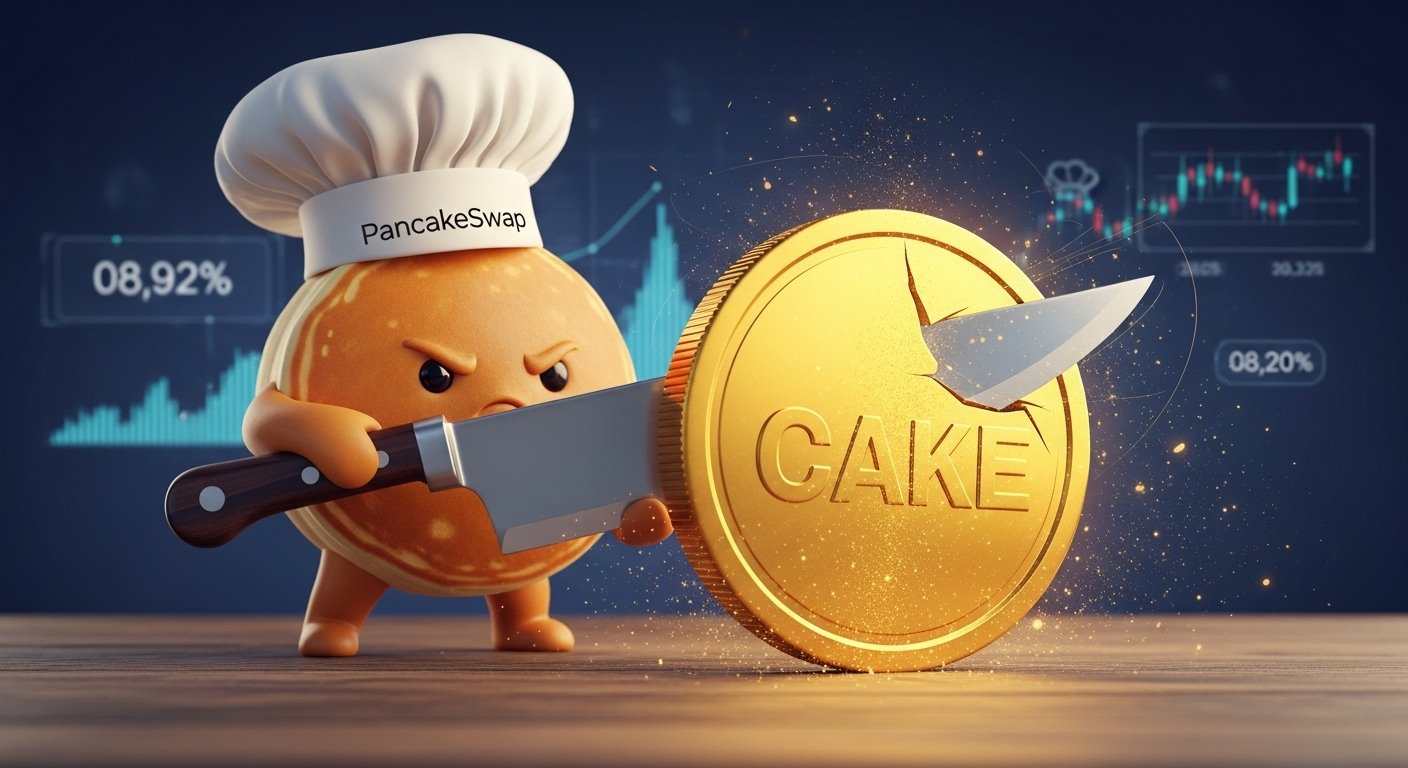
PancakeSwap Slashes CAKE has long been one of the most recognizable names in DeFi, and its CAKE token has been at the center of that story—sometimes celebrated for utility and sometimes criticized for emissions-driven inflation. In January 2026, PancakeSwap reignited the tokenomics conversation with a bold move: a governance push to slash the CAKE max supply to 400 million.
At first glance, a lower cap sounds simple—just reduce the number. But the implications are much deeper. For a protocol token, the maximum supply shapes everything from long-term scarcity and investor expectations to emissions schedules, yield incentives, and how sustainable rewards can be over multiple market cycles. PancakeSwap’s plan to reduce the CAKE max supply from 450M to 400M isn’t merely cosmetic; it’s designed to cement a more deflationary tokenomics path that the protocol says has already been working since Tokenomics 3.0.
This article breaks down what “PancakeSwap slashes CAKE max supply to 400M” actually means, how it connects to Tokenomics 3.0, why the community is discussing it now, and what holders, liquidity providers, and DeFi users should realistically expect next.
What Does “PancakeSwap Slashes CAKE Max Supply to 400M” Mean?
When people read that PancakeSwap slashes CAKE max supply to 400M, the key phrase is max supply. Maximum supply is the hard ceiling on how many CAKE tokens can ever exist. According to PancakeSwap’s own community forum discussion, the proposal targets a reduction of the CAKE max supply from 450 million to 400 million, an effective cut of 50 million CAKE from the long-term cap.
It’s important to separate max supply from circulating supply. Circulating supply is the amount currently available in the market, while max supply is the ultimate limit that can be minted or released over time. PancakeSwap’s forum post indicates circulating supply was around the mid-300M range at the time of the discussion (roughly ~350M), meaning a 400M cap leaves a smaller buffer for future emissions or ecosystem needs.
In plain terms, “PancakeSwap slashes CAKE max supply to 400M” is a commitment to tighter long-run supply—closer to the current circulation—rather than leaving a larger future issuance runway.
Why PancakeSwap Wants a Lower CAKE Max Supply Now
PancakeSwap’s reasoning is rooted in a multi-year shift away from high emissions and toward sustainability. In the official discussion, PancakeSwap references Tokenomics 3.0 (passed in April 2025) as the turning point that reduced emissions and helped the token become net deflationary across 2025.
The Tokenomics 3.0 backdrop
Under Tokenomics 3.0, PancakeSwap says it retired the veCAKE model and reduced daily CAKE emissions from roughly ~40,000 to ~22,500 per day. That matters because emissions are the main source of inflation for many DeFi tokens. Lower emissions mean fewer new tokens entering circulation, which makes it easier for burns and fee-driven sinks to offset issuance.
Deflation as a narrative—and a measurable trend
The same forum discussion notes PancakeSwap achieved a net burn of about ~8.19% of CAKE’s token supply in 2025, with supply falling from roughly 380M at the start of the year to around ~350M later on.
That provides the foundation for the logic: if the system is already deflationary and the circulating supply is materially below 450M, then lowering the CAKE max supply to 400M is presented as aligning the hard cap with reality—while reinforcing long-term scarcity.
How the 400M Cap Could Change CAKE Tokenomics in Practice
A max supply reduction is a structural change, but it doesn’t automatically guarantee higher prices or permanent deflation. Instead, it reshapes the design space: how many tokens can be used for incentives, how conservative emissions must remain, and how aggressively the protocol can commit to burning.
A tighter ceiling forces stronger discipline
With a 450M cap, there’s more room for future issuance—even if the protocol claims it won’t use it. With a 400M cap, the buffer becomes smaller, which can pressure governance and the team (often referred to as “the Kitchen” in PancakeSwap communications) to maintain lower emissions, keep incentives efficient, and avoid returning to inflationary habits.
It strengthens the “deflationary DEX token” positioning
In a market where many governance tokens struggle to justify long-term value, scarcity narratives matter—especially when paired with usage and fee capture. PancakeSwap’s proposal has been widely framed across crypto media as part of a broader deflation-first approach.
That’s why “PancakeSwap slashes CAKE max supply to 400M” has resonance: it’s not just mechanics, it’s messaging—aimed at making CAKE feel less like a farm-and-dump reward token and more like a durable DeFi asset.
Governance: How the CAKE Max Supply Decision Gets Made
PancakeSwap is a governance-driven protocol, and this change is presented as a community decision through formal discussion and voting processes. Multiple outlets reported that PancakeSwap opened a governance vote specifically to cut the CAKE max supply to 400M, framing it as a step toward lower emissions and stronger long-term token economics.
From a governance perspective, supply cap changes are high-impact because they alter long-term expectations. That typically increases participation, debate, and sometimes speculation around the vote window.
Even if you’re not actively voting, the process matters because it reveals community priorities: whether users value aggressive incentives (more emissions) or sustainable scarcity (less issuance and more burn pressure).
What This Means for CAKE Holders
If PancakeSwap slashes CAKE max supply to 400M, holders generally interpret it as a more scarcity-aligned token structure. But it’s worth being precise: a lower max supply does not directly change the number of tokens you own, and it doesn’t instantly remove tokens from circulation. It changes the long-run endpoint.
Potential upside: stronger scarcity expectations
Markets often price narratives and constraints. If the community credibly commits to a 400M cap, it may reduce fears of future dilution. That can improve sentiment—especially among longer-term participants who were previously cautious about emissions.
Some reports noted that discussion around the supply cut coincided with increased market attention and price activity, reflecting how tokenomics headlines can influence short-term momentum.
Potential trade-off: fewer tokens available for future incentives
The flip side is that incentive design may need to become more efficient. DeFi platforms often rely on token rewards to attract liquidity. With a tighter cap, PancakeSwap may have less flexibility to “brute force” growth via emissions, pushing it to rely more on real yield, fee-based rewards, and product-driven demand.
For long-term holders, that can be a good thing—if it improves sustainability. For short-term farmers, it can be less attractive—if yields fall.
What It Means for Liquidity Providers, Yield Farmers, and DeFi Users
PancakeSwap is a BNB Chain DEX at its core, and CAKE incentives have historically played a major role in liquidity depth and user growth. A 400M CAKE max supply pushes the ecosystem toward a model where liquidity and engagement are supported more by actual usage and less by inflationary token rewards.
Liquidity incentives may evolve
With Tokenomics 3.0 already reducing daily emissions, the direction of travel is clear: fewer rewards printed per day, more emphasis on sustainable reward sources, and a stronger deflation narrative.
If PancakeSwap slashes CAKE max supply to 400M, you should expect ongoing optimization of incentive programs—potentially more targeted emissions, more dynamic reward routing, and greater reliance on revenue-linked mechanisms.
User experience could improve if incentives become healthier
Over time, protocols that depend too much on emissions can struggle when market conditions tighten. A system designed around lower emissions and stronger burn/fee dynamics can be more resilient—meaning less boom-and-bust behavior in rewards and liquidity.
That’s the deeper thesis behind “PancakeSwap slashes CAKE max supply to 400M”: it’s a bet on durability.
Market Reaction and Why Tokenomics Headlines Move Prices
Crypto markets love simple narratives, and supply changes are among the simplest. “Lower supply” is easy to understand, even if the real-world impact is nuanced.
Coverage of PancakeSwap’s supply reduction discussion and governance steps repeatedly highlights the 50M reduction (450M to 400M) and frames it as a scarcity push.

However, it’s wise to remember that max supply reductions are not the same as immediate circulating supply burns. The market can react positively even if fundamentals change slowly, and it can also fade quickly if the protocol’s revenue, usage, or incentives don’t support the narrative.
In other words, tokenomics is the “rules,” but adoption is the “engine.”
Risks, Caveats, and What This Change Does Not Guarantee
Even if PancakeSwap slashes CAKE max supply to 400M, several realities remain:
A lower cap doesn’t automatically mean constant deflation
Deflation depends on the balance between emissions and burns. Tokenomics 3.0 appears to have enabled net burn conditions in 2025, but future market cycles, usage, and governance decisions can change outcomes.
Governance can evolve again
DeFi governance is not “set and forget.” A future community could propose changes—though reversing a scarcity move can be politically difficult. Still, anyone evaluating CAKE should treat tokenomics as a living system.
Incentive competition in DeFi is relentless
Even with a stronger scarcity framework, PancakeSwap competes with other DEXs and DeFi protocols for liquidity. If competitors offer higher yields, better UX, or better execution, PancakeSwap still has to win users. A 400M cap helps narratives and sustainability, but it doesn’t replace product advantage.
How to Track the Proposal, Vote, and On-Chain Follow-Through
If you want to monitor whether “PancakeSwap slashes CAKE max supply to 400M” becomes fully implemented, the best starting point is PancakeSwap’s governance forum thread, which documents the rationale, emissions changes, and the intended cap reduction.
From there, you can follow the linked governance steps and watch for official implementation updates. Market event trackers also referenced a January 2026 vote window related to the max supply reduction.
The key is to distinguish three phases: discussion, vote, and implementation. Headlines often compress these into one moment, but real governance changes only become permanent once implemented in the protocol’s token parameters.
The Bigger Picture: Why DeFi Tokens Are Shifting to Scarcity and “Real Yield”
PancakeSwap is not alone in trying to improve token sustainability. Across DeFi, many protocols have been moving away from “print tokens to grow” and toward mechanisms that emphasize fees, buybacks, burns, and revenue-linked rewards—often grouped under the broad idea of real yield.
The CAKE story fits that arc. Tokenomics 3.0 reduced emissions, and the 400M cap proposal attempts to lock in long-term scarcity discipline.
For searchers and investors, this is why “PancakeSwap slashes CAKE max supply to 400M” matters: it’s a signal that PancakeSwap wants CAKE’s value proposition to be driven more by protocol success and less by inflationary distribution.
Conclusion
PancakeSwap slashes CAKE max supply to 400M as part of a broader attempt to strengthen CAKE’s long-term token economics, reinforce scarcity, and build on the deflationary momentum it says followed Tokenomics 3.0. The official proposal frames the move as a logical next step after emissions were reduced (from ~40,000 to ~22,500 per day) and after 2025 reportedly saw net supply contraction of about 8.19%, with total supply falling from around 380M to about 350M.
Still, the real impact depends on sustained execution: continued discipline on emissions, continued demand for PancakeSwap’s products, and governance follow-through. A 400M cap can strengthen confidence and narratives, but the long-term outcome will be shaped by usage, revenue, and whether CAKE’s utility keeps expanding in a competitive DeFi landscape.
FAQs
Q: Is the CAKE max supply cut the same as burning tokens?
Not exactly. Burning reduces circulating supply by permanently removing tokens. A max supply cut reduces the long-term ceiling of how many tokens can ever exist. PancakeSwap’s proposal focuses on lowering the CAKE max supply from 450M to 400M, which changes the cap rather than instantly burning circulating tokens.
Q: Why does PancakeSwap want the CAKE max supply at 400M?
PancakeSwap argues the smaller cap better matches today’s circulating supply and reflects a shift toward deflationary design after Tokenomics 3.0 reduced emissions and supported net supply decline during 2025.
Q: Will the 400M cap increase the CAKE price?
No outcome is guaranteed. A lower CAKE max supply can improve scarcity expectations and reduce dilution concerns, but price still depends on demand, adoption, market conditions, and whether PancakeSwap keeps generating real usage and fees.
Q: Does the proposal affect current CAKE holders?
It doesn’t directly change the number of tokens you hold. The proposal reshapes long-term supply expectations and may influence future emissions and incentive structures, which can indirectly affect market dynamics over time.
Q: Where can I follow the official updates on the CAKE max supply reduction?
The best primary source is PancakeSwap’s governance forum discussion, which outlines the rationale, the emissions changes under Tokenomics 3.0, and the proposed reduction of the CAKE max supply to 400M.
