

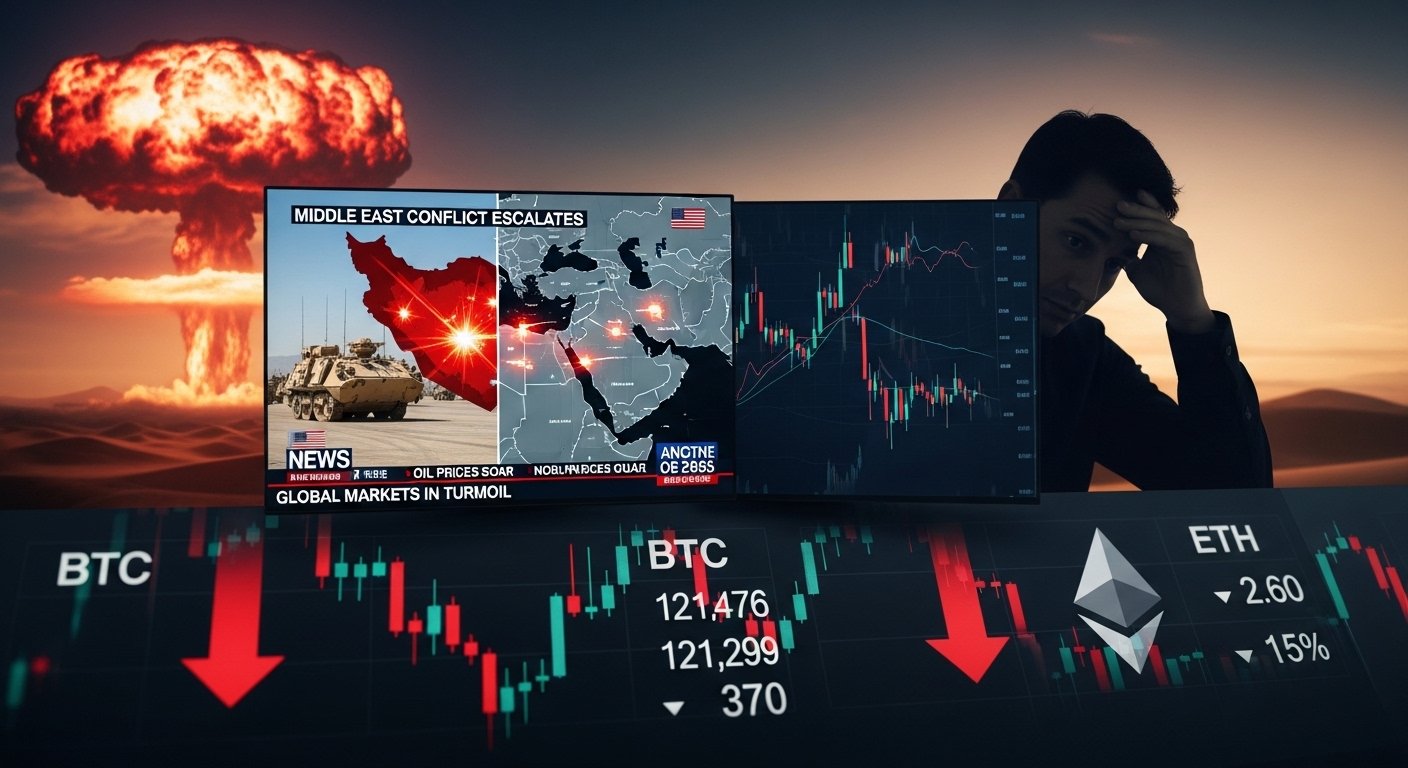
US-Iran War Bitcoin and Ethereum isn’t just a headline risk for diplomats and defense analysts—it’s a market-moving shock that can ripple through energy, currencies, equities, and, increasingly, crypto. When traders hear “war,” they immediately start repricing geopolitical risk, but the way that repricing filters into the Bitcoin and Ethereum price is not always straightforward. Sometimes conflict triggers a classic risk-off stampede into cash and short-term government bonds, dragging speculative assets lower. Other times, the same conflict can ignite oil prices, lift inflation expectations, weaken confidence in fiat stability, and strengthen the “hard asset” narrative that supports the Bitcoin and Ethereum price.
What makes a US-Iran war especially sensitive is the region’s central role in energy markets and shipping lanes. Any disruption in the Strait of Hormuz can tighten oil supply, spike shipping insurance, and strain global supply chains. That can raise inflation, challenge central banks, and reshape global liquidity conditions—the real engine behind the Bitcoin and Ethereum price in many cycles. At the same time, a war could intensify sanctions, capital controls, and payment restrictions, pushing more people and businesses to seek alternative rails such as stablecoins, decentralized finance, and censorship-resistant settlement.
In other words, the Bitcoin and Ethereum price could react through multiple channels at once: macro conditions, investor sentiment, market structure, and crypto-specific fundamentals. This article breaks down those channels, explores plausible scenarios, and highlights what traders and long-term holders should actually monitor if US-Iran war risk rises.
How markets typically react to war shocks
The first phase of a war scare is usually about uncertainty, not fundamentals. Markets hate unknowns: duration, escalation, retaliation, and spillover. In that opening window, major funds often reduce leverage and rotate to perceived safety. That can weigh on the Bitcoin and Ethereum price because crypto is still widely treated as a high-beta asset—especially in the short term.
However, conflict also changes the price of essentials, particularly oil, and that can create second-order effects that matter more than the initial panic. If a US-Iran war lifts oil meaningfully, inflation expectations can jump, real yields can move, and the US dollar can strengthen or weaken depending on the policy and growth outlook. Each of those shifts has a track record of influencing the Bitcoin and Ethereum price.
The “risk-off” impulse and crypto’s short-term correlation
In the early hours of a geopolitical shock, many traders sell what they can sell quickly. Crypto trades 24/7 with deep global liquidity, so it often becomes the outlet for fast de-risking. That dynamic can pull the Bitcoin and Ethereum price down even if the long-term thesis for censorship resistance and non-sovereign money becomes more compelling.
At the same time, correlations aren’t static. During some stress events, Bitcoin has traded like “digital gold,” while in others it has behaved like a levered tech stock. The market’s interpretation depends on positioning, leverage, and whether the dominant narrative is safe-haven asset or risk-on speculation.
Oil, inflation, and the macro domino effect
A US-Iran war can matter to oil more than many other conflicts because Iran sits near a crucial chokepoint for global crude flows. If oil spikes, transportation and manufacturing costs rise. That can reignite inflation fears, and inflation is one of the macro variables most linked to the Bitcoin and Ethereum price through the lens of monetary policy.
If inflation jumps, central banks may stay tighter for longer, raising real yields and reducing global liquidity—often negative for the Bitcoin and Ethereum price. But if inflation surges while growth weakens, policy credibility can be questioned, and the “hard money” narrative can strengthen. That’s when Bitcoin’s role as an inflation hedge becomes part of the mainstream conversation again, potentially supporting the Bitcoin and Ethereum price after the initial shock passes.
Why a US-Iran war is uniquely relevant for crypto
A US-Iran war isn’t only about bombs and borders; it’s also about money movement. Iran has faced extensive sanctions and restrictions for years, and further escalation could expand financial isolation, disrupt remittances, or restrict access to international banking. In such environments, people often adopt alternative settlement tools—whether that’s physical cash, gold, or digital assets.
Crypto’s relevance increases when traditional payment rails become less reliable or more surveilled. Even if adoption flows are small relative to global markets, they can influence sentiment, narratives, and policy reactions—each of which can move the Bitcoin and Ethereum price.
Sanctions, payment friction, and alternative rails
Stronger sanctions can limit access to correspondent banking, card networks, and cross-border settlement. That raises the appeal of stablecoins, which act like dollar proxies on blockchain rails. A rise in stablecoin usage can improve crypto market liquidity and trading activity, indirectly affecting the Bitcoin and Ethereum price.
However, sanctions-related narratives can also bring regulatory scrutiny. Governments may tighten exchange compliance, raise monitoring requirements, or pressure on-ramps and off-ramps. That can reduce liquidity in certain regions and increase friction for legitimate users, which may temporarily weigh on the Bitcoin and Ethereum price through lower market depth and higher spreads.
Capital controls and the “escape valve” demand
In war-adjacent situations, capital controls become more likely. When access to foreign currency tightens and confidence in local money falls, individuals look for assets that can be moved, stored, and converted more easily. Bitcoin’s portability and censorship resistance can make it a perceived “escape valve,” increasing spot demand in pockets of stress.
That said, local demand does not automatically translate into a global bull run for the Bitcoin and Ethereum price. The global price is still set by large pools of liquidity on major exchanges and by macro flows. But localized demand surges can reinforce the broader narrative that crypto has real-world utility beyond speculation—often supportive for the Bitcoin and Ethereum price over longer horizons.
The key transmission channels that could move Bitcoin and Ethereum
To understand what a US-Iran war could mean for the Bitcoin and Ethereum price, it helps to break the story into a few specific channels. Think of these as the “pipes” through which war risk flows into crypto markets.
Channel 1: Global liquidity and central bank expectations
The most powerful driver of the Bitcoin and Ethereum price in recent cycles has been liquidity—how easy it is to borrow, how attractive cash yields are, and how much speculative capital is willing to take risk. If war risk triggers an oil-driven inflation spike, central banks may keep policy tighter, which can reduce liquidity and pressure the Bitcoin and Ethereum price. If, instead, war uncertainty damages growth enough to push policymakers toward easing or stimulus, liquidity can rise, often lifting the Bitcoin and Ethereum price. The outcome depends on which fear dominates: inflation or recession.
Channel 2: US dollar strength and FX volatility
The US dollar can behave in conflicting ways during geopolitical stress. Sometimes it strengthens due to safe-haven demand; other times it weakens if markets price fiscal strain, political uncertainty, or a shift in global confidence. A stronger dollar often tightens financial conditions and can weigh on the Bitcoin and Ethereum price. A weaker dollar can support commodities and alternative stores of value, potentially benefiting the Bitcoin and Ethereum price—especially if the narrative shifts toward debasement concerns.
Channel 3: Energy shock and mining economics
Bitcoin mining is directly exposed to energy costs. A large oil move can spill into gas and electricity pricing in some regions, influencing miner margins. If energy costs rise sharply, inefficient miners may capitulate, causing a temporary hashrate dip or selling pressure from miner treasuries. That can create volatility in the Bitcoin and Ethereum price. Ethereum, after its shift away from proof-of-work, is less directly tied to energy costs. But it is sensitive to broader risk appetite and to network activity, which can change if conflict affects global economic activity or trading volumes.
Channel 4: Market structure, leverage, and liquidations
Crypto’s short-term moves are often amplified by leverage. If a US-Iran war headline hits when derivatives funding is stretched, the Bitcoin and Ethereum price can cascade through liquidations. A relatively small spot move can trigger forced selling, worsening the drop. Conversely, if positioning is light and the market is hedged, the same headline may cause only a brief dip before buyers step in. That’s why tracking funding rates, open interest, and liquidation clusters matters when assessing what a US-Iran war could mean for the Bitcoin and Ethereum price.
Channel 5: Regulation, compliance, and on-ramps
Conflict tied to sanctions can motivate policymakers to tighten oversight of exchanges, mixers, and privacy tools. Even if the intent is national security, the market can interpret it as a liquidity threat. When on-ramps face friction, the Bitcoin and Ethereum price may suffer from reduced participation. But the reverse can also happen: stricter oversight can bring institutional comfort over time, improving market integrity. The near-term effect is usually volatility; the long-term effect depends on how rules are implemented.
Scenario analysis: What happens to Bitcoin and Ethereum in different war outcomes?
No one can forecast geopolitics with certainty, but we can map plausible scenarios and how each might affect the Bitcoin and Ethereum price. The key is time horizon: what happens in the first 24–72 hours can be the opposite of what happens over the following months.
Scenario A: Short, contained conflict with limited oil disruption
If a US-Iran war remains limited and shipping lanes stay open, markets may experience a brief risk-off shock and then revert. In this case, the Bitcoin and Ethereum price could dip initially due to de-risking, then recover as uncertainty fades and traders rebuild positions. In this scenario, Ethereum could outperform Bitcoin if risk appetite returns quickly, because ETH is often treated as more “growth-like,” benefiting from renewed speculative flows into DeFi, NFTs, and broader altcoin activity. The Bitcoin and Ethereum price relationship might resemble a typical macro scare: sharp drop, fast rebound.
Scenario B: Escalation that meaningfully lifts oil and inflation
If conflict disrupts oil flows or triggers fear of disruption, oil prices can surge. Inflation expectations can rise, and central banks may face a harder job. If policymakers lean hawkish to protect credibility, liquidity can tighten and weigh on the Bitcoin and Ethereum price for longer than a weekend headline.
Yet if inflation spikes while trust in fiat purchasing power erodes, Bitcoin’s “hard asset” narrative can regain traction. In that case, the Bitcoin and Ethereum price might show an initial drawdown followed by a more durable bid as investors diversify into scarce assets. Ethereum’s path would depend on whether network activity stays strong and whether risk appetite survives tighter conditions.
Scenario C: Prolonged regional instability and global recession risk
A prolonged US-Iran war scenario could damage business confidence and global trade. If recession risk becomes dominant, central banks may eventually pivot toward easing. That pivot—if it arrives—has historically been supportive for the Bitcoin and Ethereum price through improved liquidity expectations. The tricky part is timing. Recession fear can cause investors to sell first and ask questions later. The Bitcoin and Ethereum price can suffer in the “risk-off recession” phase, then rally strongly once policy easing and liquidity return.
Scenario D: Sanctions escalation, financial fragmentation, and crypto rail adoption
If the conflict accelerates financial fragmentation—more sanctions, more compliance barriers, more restricted banking—crypto rails may see higher usage, especially via stablecoins. That can increase crypto market volume, improve liquidity, and reinforce adoption narratives. Over time, that can be constructive for the Bitcoin and Ethereum price. But this scenario also increases policy risk. If regulators respond aggressively to enforce sanctions, they may pressure centralized exchanges and custodians. The Bitcoin and Ethereum price could see volatility tied to enforcement announcements even as underlying adoption grows.
Bitcoin vs. Ethereum: Why the reactions may differ
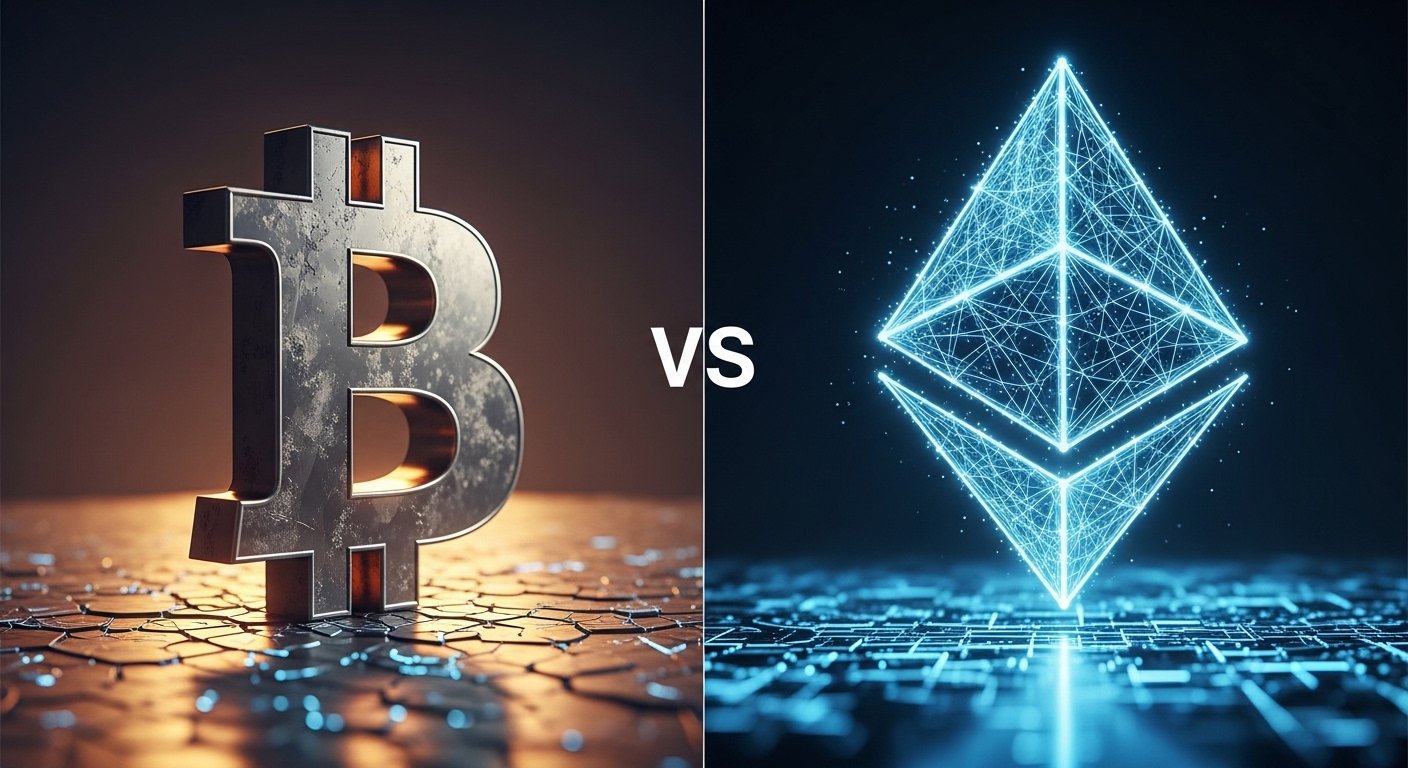
Although Bitcoin and Ethereum often move together, a US-Iran war can affect them differently because their market roles differ. Bitcoin is primarily valued as digital scarcity and neutral settlement, so its narrative leans toward store of value and safe-haven asset. Ethereum is valued as a programmable settlement layer, so its narrative leans toward usage, applications, and network economics. That difference matters when the driver is war-related uncertainty rather than a pure liquidity cycle.
Bitcoin’s “digital gold” narrative in a war context
If investors interpret a US-Iran war as a sign of rising global instability, Bitcoin can benefit from the idea of an asset that is not directly tied to any single government. That does not guarantee an immediate rise in the Bitcoin and Ethereum price, but it can provide a foundation for demand after the initial shock.
Bitcoin may also benefit if inflation expectations surge and investors look for scarce assets. In that sense, what a US-Iran war could mean for the Bitcoin and Ethereum price might be “down first, up later,” with Bitcoin potentially stabilizing earlier if the store-of-value narrative takes hold.
Ethereum’s activity sensitivity and fee dynamics
Ethereum’s value is more sensitive to on-chain activity and the health of its application ecosystem. If a US-Iran war triggers a broad risk-off phase, speculative activity can slow, which may weigh on Ethereum relative to Bitcoin. On the other hand, if stablecoin settlement and on-chain trading increase due to payment friction, Ethereum can benefit from higher network usage, depending on where that activity settles. Ethereum can also be influenced by institutional positioning, staking dynamics, and the perception of ETH as a technology asset. That can make the Ethereum leg of the Bitcoin and Ethereum price story more volatile around geopolitical shocks.
What investors should watch if war risk rises
If you’re trying to anticipate what a US-Iran war could mean for the Bitcoin and Ethereum price, the best approach is to watch the variables that actually move markets rather than the loudest takes on social media. Oil is a big one, because it transmits war risk into inflation and policy. Real yields and the US dollar matter because they reflect financial conditions. In crypto-native indicators, watch leverage, funding, and exchange flows.
If stablecoin supply and exchange balances rise, liquidity is increasing; if exchange reserves fall while long-term holders accumulate, supply tightens—often supportive for the Bitcoin and Ethereum price. Also watch policy signals. Statements about sanctions enforcement, exchange compliance, and cross-border payment monitoring can affect market access and sentiment, creating sharp moves in the Bitcoin and Ethereum price even without changes in fundamentals.
Conclusion
A US-Iran war could mean volatility first and clarity later for the Bitcoin and Ethereum price. In the opening stage, fear, leverage unwinds, and risk-off positioning can push crypto lower because it remains a fast, liquid outlet for de-risking. But the medium-term impact depends on oil, inflation, and central bank responses—plus the extent to which conflict deepens sanctions, payment friction, and capital controls.
If oil disruption is limited and the conflict is contained, the Bitcoin and Ethereum price may experience a brief shock and recovery. If oil spikes and inflation re-accelerates, crypto could fall on tighter liquidity fears, then rebound if the store-of-value narrative strengthens. If prolonged instability raises recession risk, crypto can suffer during the contraction phase but potentially rally when easing and liquidity return. And if financial fragmentation expands, crypto rails—especially stablecoins and blockchain settlement—may see greater relevance, shaping sentiment and long-term adoption for both Bitcoin and Ethereum.
Ultimately, what a US-Iran war could mean for the Bitcoin and Ethereum price is not one simple direction. It’s a sequence: headline reaction, macro repricing, liquidity response, and then a narrative shift as markets decide whether crypto is “risk-on beta” or a resilient alternative in an unstable world.
FAQs
Q: Will a US-Iran war automatically make Bitcoin go up?
Not automatically. In the short term, a US-Iran war can trigger risk-off selling that pushes the Bitcoin and Ethereum price down. Whether Bitcoin rises later depends on oil, inflation, and how monetary policy and liquidity evolve.
Q: Why do oil prices matter so much for the Bitcoin and Ethereum price?
Oil is a primary channel for war to affect inflation and growth. If oil rises sharply, inflation expectations can increase and central banks may stay tighter, reducing global liquidity, which often pressures the Bitcoin and Ethereum price.
Q: Would Ethereum react differently than Bitcoin during a war shock?
Often, yes. Bitcoin can benefit more from store of value and safe-haven asset narratives, while Ethereum is more sensitive to risk appetite and network activity. That can make Ethereum more volatile in the initial phase of a US-Iran war scare.
Q: Could sanctions and capital controls increase crypto adoption?
They can. When banking access is restricted or cross-border payments become harder, people may rely more on stablecoins and blockchain settlement. That can support liquidity and usage narratives that influence the Bitcoin and Ethereum price, though regulatory crackdowns can also add volatility.
Q: What indicators should I track if US-Iran war risk escalates?
Watch oil, the US dollar, real yields, and central bank messaging for macro direction. In crypto, monitor derivatives leverage, funding rates, exchange flows, and stablecoin supply trends to gauge whether conditions are supportive or risky for the Bitcoin and Ethereum price.
