

Crypto market has a habit of rewarding patience—and punishing assumptions. When altcoin season arrives, narratives move faster than fundamentals, and price action can make even strong investors forget their own thesis. But the bigger question for long-term holders isn’t just which token pumps the hardest in a few weeks. It’s which ecosystem can earn staying power when hype fades and builders, institutions, and everyday users decide where value really lives.
That’s why the debate around XRP vs Ethereum vs Solana matters heading into 2026. These aren’t three random names on a coin tracker. They represent three very different approaches to blockchain adoption. XRP focuses on payments infrastructure and enterprise rails. Ethereum remains the heavyweight hub for smart contracts and decentralized finance. Solana pushes for high throughput, cheap transactions, and consumer-grade crypto apps at scale. If a true altcoin season arrives in 2026, it likely won’t lift every project equally. Capital tends to concentrate in chains with momentum, liquidity, and clear use cases.
At the same time, the market context in 2026 could look very different from previous cycles. Regulation is evolving, major financial institutions are experimenting with tokenization, and on-chain applications are becoming more user-friendly. In that environment, the XRP vs Ethereum vs Solana conversation becomes less about tribal loyalty and more about measurable strengths: network effects, developer traction, scalability, fee predictability, security assumptions, and the ability to survive real-world stress.
This article breaks down XRP vs Ethereum vs Solana in a 2026-focused way. We’ll explore what each chain is best at, what could go wrong, and which signals matter most if altcoin season actually shows up. The goal isn’t to declare a guaranteed winner—crypto doesn’t work like that. The goal is to help you think like a strategist, not a gambler, while staying grounded in what tends to drive sustained dominance over time.
What “Dominating 2026” Really Means in Crypto
“Dominance” is often confused with price. In a frenzy, the biggest winner may simply be the token with the most leverage in its narrative. But real dominance is broader. When comparing XRP vs Ethereum vs Solana, it helps to define what winning in 2026 might look like across multiple categories.
Market Dominance vs Ecosystem Dominance
Market dominance is the obvious one: market cap, trading volume, liquidity, and mindshare. If altcoin season gets loud, the coins that dominate headlines and exchanges usually see the fastest inflows. But ecosystem dominance is what persists beyond the cycle. That includes developer activity, application depth, the quality of DeFi liquidity, the strength of stablecoin rails, integrations with wallets and payment services, and whether new projects choose that chain first.
Ethereum has historically led on ecosystem dominance, while Solana has aggressively competed on user experience and speed. XRP sits in a different lane, where “dominance” could mean becoming a key settlement layer for institutions and cross-border value transfer, even if the chain doesn’t host the same kind of consumer apps.
The 2026 Scoreboard: Metrics That Will Matter
A smarter way to evaluate XRP vs Ethereum vs Solana is to watch where real traction shows up. In 2026, the most relevant scoreboard will likely include total value locked, stablecoin usage, real transaction demand (not just spam), developer retention, uptime reliability, costs at scale, and institutional integrations. Add to that regulatory clarity and compliance friendliness—because the biggest pools of capital rarely move without guardrails.
If altcoin season arrives, short-term price may spike everywhere. But the chain that “dominates 2026” will be the one that attracts and retains users when the market calms down.
XRP in 2026: Payments Narrative, Enterprise Rails, and Regulation
The XRP side of XRP vs Ethereum vs Solana is often misunderstood because it doesn’t fit the typical “build DeFi apps and NFTs” framework. XRP has long leaned into cross-border payments, settlement efficiency, and partnerships aimed at making value transfer cheaper and faster. For 2026, that positioning can either look brilliant—or limited—depending on what kind of crypto adoption accelerates.
XRP’s Core Strength: Fast Settlement and Payment Efficiency
XRP’s pitch is simple: move value quickly with low fees. That is a real advantage in a world where people still pay high fees for international transfers and where settlement can be slower than the internet itself. If crypto becomes more embedded in financial plumbing by 2026, XRP’s alignment with payment utility could become a strong tailwind.
In the XRP vs Ethereum vs Solana discussion, XRP often wins on payment specialization. It isn’t trying to be everything. It aims to be extremely good at value transfer. That focus can be powerful if institutions prioritize reliability and cost over composable on-chain experiments.
The Biggest Variable: Institutional Adoption and Legal Overhang
XRP’s 2026 outlook is tied closely to institutional comfort and the broader regulatory landscape. When institutions adopt crypto infrastructure, they care about governance, risk controls, and clarity more than maximal decentralization narratives. XRP’s brand recognition and enterprise-first posture can help here.
However, legal uncertainty and public perception can act as friction. In a strong altcoin season, retail may not care. But to “dominate 2026” in a lasting way, XRP needs a narrative that connects to real usage growth. If payment corridors, remittance providers, or financial platforms expand adoption, the XRP vs Ethereum vs Solana race gets more interesting because XRP would be winning where the biggest money actually moves.
XRP’s Competitive Challenge: Limited App Ecosystem
If 2026’s altcoin season is fueled by consumer apps—gaming, social, memecoins, and creator economy tools—XRP may not be the first stop for developers. Ethereum and Solana are more associated with smart contracts, composability, and application layers. This doesn’t disqualify XRP; it just means XRP’s dominance would likely come from being a backbone utility, not a playground for new on-chain trends.
For investors evaluating XRP vs Ethereum vs Solana, the key is matching the token’s strengths with the adoption wave you believe is coming.
Ethereum in 2026: The Settlement Layer for Smart Contracts and Finance
Ethereum remains the most established choice in the XRP vs Ethereum vs Solana comparison for builders who want deep liquidity, mature tooling, and the strongest network effects in crypto applications. If you think 2026 will reward infrastructure with the broadest base of developers and capital, Ethereum is difficult to ignore.
Ethereum’s Moat: Network Effects and Developer Gravity
Ethereum’s biggest advantage is not speed. It’s gravity. Developers build where other developers are. Liquidity pools form where liquidity already exists. Standards emerge where the most economic activity takes place. This is why Ethereum often behaves like a default settlement layer for DeFi, tokenized assets, and complex smart contract systems.
In the XRP vs Ethereum vs Solana debate, Ethereum’s dominance case is that it continues to be the most trusted platform for high-value on-chain finance. When the stakes are high—large treasuries, institutional-grade protocols, major stablecoin flows—conservatism matters, and Ethereum’s reputation can become its own form of value.
Scalability and Fees: The L2 Reality in 2026
Ethereum’s 2026 story depends heavily on scaling through layer-2 networks. Instead of trying to cram everything onto the base layer, Ethereum increasingly relies on rollups and other scaling solutions to offer cheaper and faster transactions while keeping the base layer as a highly secure settlement engine.
That means when you compare XRP vs Ethereum vs Solana, the question becomes less “Is Ethereum fast?” and more “Is the Ethereum ecosystem scalable enough as a whole?” If L2 user experiences become seamless—bridging pain minimized, wallets abstract complexity, fees stay predictable—Ethereum can capture mass adoption without sacrificing its security-first posture.
The Risk: Fragmentation and UX Complexity
Ethereum’s greatest weakness can be its own success. Multiple L2s, bridges, and app-specific environments can create a fragmented user experience. In altcoin season, complexity is forgiven. In the real world, friction kills adoption.
Solana’s supporters often argue that a single high-throughput layer-1 blockchain creates a smoother consumer experience. Ethereum’s counterargument is that modular scaling offers resilience and specialization. In 2026, whichever approach feels simplest to users may win mindshare, which directly affects the XRP vs Ethereum vs Solana race.
Solana in 2026: High Throughput, Low Fees, and Consumer Crypto
Solana’s role in XRP vs Ethereum vs Solana is the speed-and-scale challenger. Its brand is tied to performance, low transaction costs, and a developer culture pushing consumer-facing crypto apps. If 2026’s altcoin season is driven by mainstream usage—trading, gaming, social apps, and payments-like experiences—Solana has a straightforward pitch.
Solana’s Strength: Scalability and User-Friendly Costs
Solana is designed for high throughput and low fees, which matters when users are making many small transactions. This is especially relevant for on-chain games, micro-transactions, social interactions, and high-frequency trading behaviors. When activity surges during altcoin season, chains that keep fees low can capture huge waves of users.
In the XRP vs Ethereum vs Solana comparison, Solana often wins on ease of “just using crypto” without thinking about gas costs or complex scaling layers. If the average user in 2026 expects apps to feel as smooth as Web2, Solana’s design philosophy becomes a major advantage.
Solana’s Ecosystem: DeFi, NFTs, and Emerging Consumer Apps
Solana has built a strong presence in NFTs, trading, and consumer-first crypto experiences. It has also become known for vibrant communities and fast-moving experimentation. In a hype-driven altcoin season, that energy can translate into rapid ecosystem expansion, especially if builders keep shipping applications that people actually want to use.
This matters because “dominance” isn’t only measured by market cap. It’s measured by where culture and users go. Solana can lead that part of the XRP vs Ethereum vs Solana story if it continues delivering reliable performance at scale.
The Risk: Reliability and Perception Under Pressure
A high-performance chain must prove itself when demand spikes. If a chain is perceived as unstable, even if improvements are real, that perception can linger. For Solana in 2026, the key question is whether it can maintain strong uptime and smooth performance during surges.
If Solana demonstrates consistent reliability, its dominance narrative strengthens significantly. If it struggles during peak periods, Ethereum’s security-first approach and XRP’s enterprise utility may look more attractive depending on what the market values at that moment.
Head-to-Head: XRP vs Ethereum vs Solana Across Key 2026 Factors
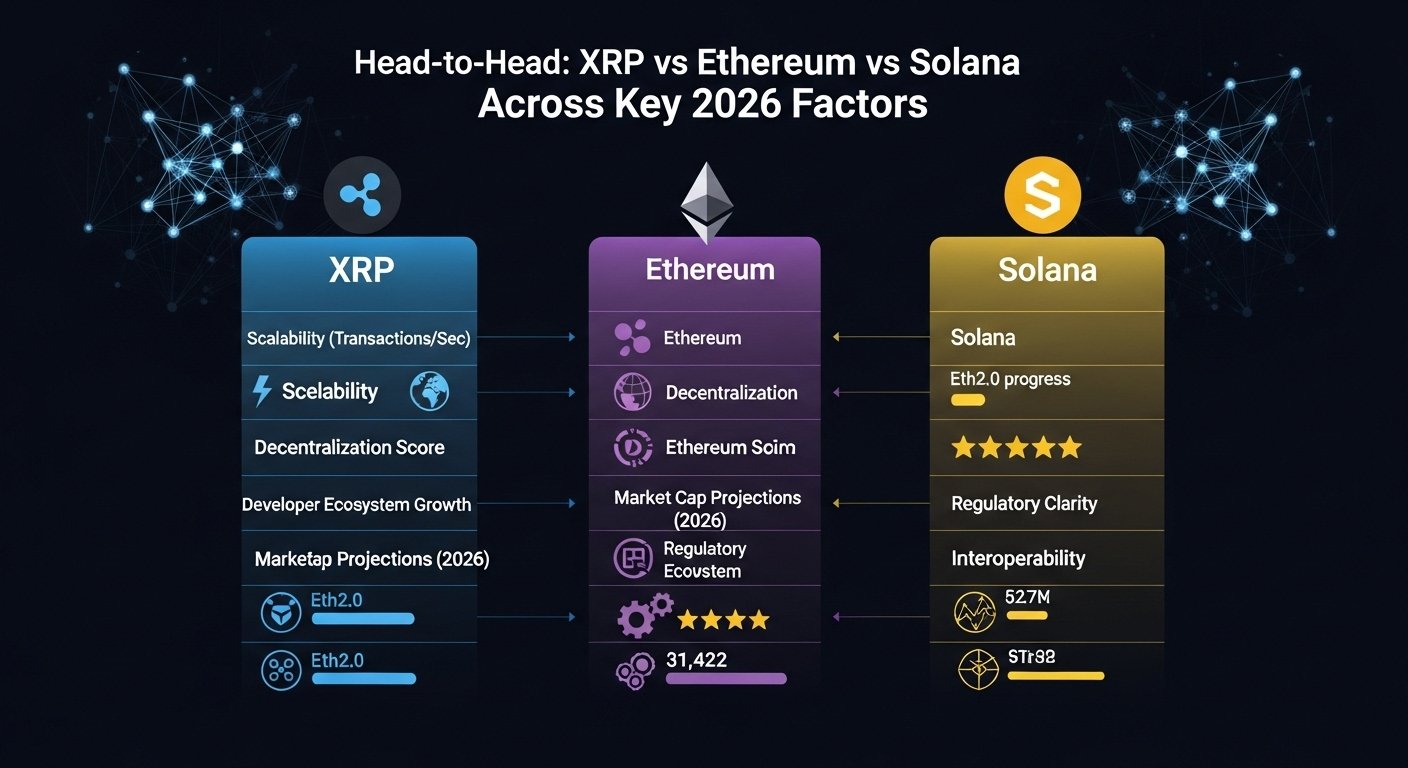
The cleanest way to understand XRP vs Ethereum vs Solana is to compare what each does best and where each faces trade-offs. In 2026, different adoption waves could favor different chains.
Use Case Fit: Payments vs Smart Contracts vs Consumer Apps
XRP is best positioned for cross-border payments and settlement-style usage, especially if enterprise adoption accelerates. Ethereum is best positioned as the foundational layer for complex smart contracts, tokenized finance, and high-value on-chain systems. Solana is best positioned for high-frequency consumer applications where low fees and speed make the difference between growth and abandonment.
If 2026’s altcoin season is driven by institutional tokenization and on-chain finance, Ethereum’s position strengthens. If it’s driven by consumer apps and high-volume trading behaviors, Solana can capture the narrative. If it’s driven by a payments revolution and compliant rails, XRP’s niche becomes more valuable.
Security, Decentralization, and Trust
Ethereum is often treated as the conservative choice within smart contract ecosystems due to its history, security posture, and decentralization narrative. Solana prioritizes performance and is building trust through real-world usage and maturing infrastructure. XRP focuses on reliability and enterprise alignment, which can appeal to institutional actors.
In the XRP vs Ethereum vs Solana debate, “trust” means different things to different audiences. For developers, trust may mean secure composability and battle-tested environments. For institutions, trust may mean governance clarity and predictable operational behavior. For users, trust may simply mean the app doesn’t break when they tap a button.
Token Utility: Fees, Staking, and Economic Design
Ethereum’s token utility includes securing the network and paying for execution, with staking playing a central role. Solana also has staking and fee utility, with the added emphasis on high-volume, low-cost activity. XRP’s token utility is more tied to settlement and transaction usage in its ecosystem.
If altcoin season arrives, speculation can overpower utility temporarily. But in 2026, the tokens that retain value tend to have clear roles in systems people keep using.
Scenarios: Who “Dominates” If Altcoin Season Hits in 2026?
Altcoin season doesn’t arrive as a single event. It shows up as a phase where liquidity rotates from Bitcoin into altcoins, narratives expand, and risk appetite increases. The XRP vs Ethereum vs Solana outcome depends on what kind of altcoin season it is.
Scenario 1: Institutional Tokenization Leads the Cycle
If tokenized real-world assets, regulated stablecoin growth, and institutional DeFi dominate the narrative, Ethereum has a strong chance to lead. Its network effects, liquidity depth, and reputation for high-value settlement can position it as the primary hub for serious capital. In this scenario, XRP may also benefit if cross-border settlement gains momentum, but Ethereum likely commands the developer and protocol layer.
Scenario 2: Consumer Apps and Trading Mania Drive Adoption
If 2026 becomes the year crypto apps feel mainstream—fast wallets, social finance, integrated trading experiences—Solana can dominate mindshare. Low fees and speed become the selling point, and builders chase the chain where users are most active. In this scenario, Ethereum still wins in high-value settlement, but Solana can capture growth and attention, which matters a lot during altcoin season.
Scenario 3: Payments and Compliance Become the Narrative
If regulatory clarity and payment integrations become the dominant story, XRP can shine. When compliance becomes a feature instead of a limitation, enterprise-aligned systems often find new demand. In this case, XRP vs Ethereum vs Solana becomes less about DeFi and more about infrastructure adoption—where XRP’s specialization can become a real edge.
How to Position Yourself: Signals to Watch Before Picking a “Winner”
Trying to guess a single winner in XRP vs Ethereum vs Solana can be less effective than watching signals that tell you where the market is heading. In 2026, a few indicators can reveal which chain is actually pulling away.
Look for sustained growth in real users, not just wallets created. Watch stablecoin activity and settlement volume patterns. Track developer traction, new application launches, and whether successful apps stay loyal to one chain or migrate. Pay attention to institutional adoption headlines, but also the quieter integrations that show up in payment platforms, custody services, and compliant on-ramps.
Altcoin season can amplify everything, but the strongest ecosystems tend to be those that already have momentum before the crowd notices.
Conclusion
If altcoin season arrives in 2026, the XRP vs Ethereum vs Solana debate won’t have a one-size-fits-all answer—because each chain is built to dominate a different kind of future.
Ethereum has the clearest path to long-term ecosystem dominance thanks to network effects, deep liquidity, and its role as a settlement layer for smart contracts and on-chain finance. Solana has the clearest path to consumer-driven dominance thanks to speed, low fees, and an application ecosystem that can feel more straightforward for everyday users. XRP has the clearest path to infrastructure-style dominance if payments, settlement, and compliance-focused adoption accelerate in a meaningful way.
The most realistic outcome is that 2026 rewards more than one winner depending on the narrative wave. But if you’re choosing which chain is most likely to “dominate” across the widest range of outcomes, Ethereum’s breadth still stands out. If you’re betting on the next generation of consumer apps and high-volume on-chain activity, Solana’s design makes it a top contender. If you believe global payments rails and enterprise settlement will be the breakout story, XRP remains uniquely positioned.
Ultimately, the right move is to align your thesis with the adoption trend you think 2026 will favor—and to keep watching the signals that confirm or challenge that thesis as the market evolves.
FAQs
Q: Is XRP vs Ethereum vs Solana a fair comparison for 2026?
Yes, but only if you compare them by role. XRP is primarily a payments and settlement-focused network, while Ethereum and Solana compete more directly in smart contract ecosystems. The comparison is useful because capital often rotates across all three during altcoin season, even if their core purposes differ.
Q: Which is better for DeFi in 2026: Ethereum or Solana?
Ethereum is likely to remain the deepest hub for DeFi liquidity and composable protocols, especially for high-value applications. Solana may outperform in high-frequency, low-fee DeFi experiences that feel more consumer-friendly. The “better” choice depends on whether you prioritize liquidity depth or speed and cost.
Q: Can Solana overtake Ethereum in 2026?
It’s possible in specific categories, especially consumer adoption and high-volume apps. For overall ecosystem dominance, Ethereum’s network effects are a powerful moat. In the XRP vs Ethereum vs Solana debate, Solana’s best path to leading is sustained reliability plus breakout mainstream apps.
Q: What’s the biggest risk for each in 2026?
For XRP, the biggest risk is that adoption remains more narrative than measurable usage growth. For Ethereum, the biggest risk is fragmentation and user experience complexity across scaling solutions. For Solana, the biggest risk is reliability perception during demand spikes.
Q: If altcoin season hits, which one could pump the most?
During altcoin season, short-term pumps often follow attention, liquidity, and narrative strength rather than fundamentals. Any of XRP vs Ethereum vs Solana could lead a rally depending on what the market is obsessed with. For lasting dominance in 2026, sustained usage and ecosystem growth matter more than a brief price surge.
Also More: Best Altcoins to Buy 2026 Staking & AI Edge
