

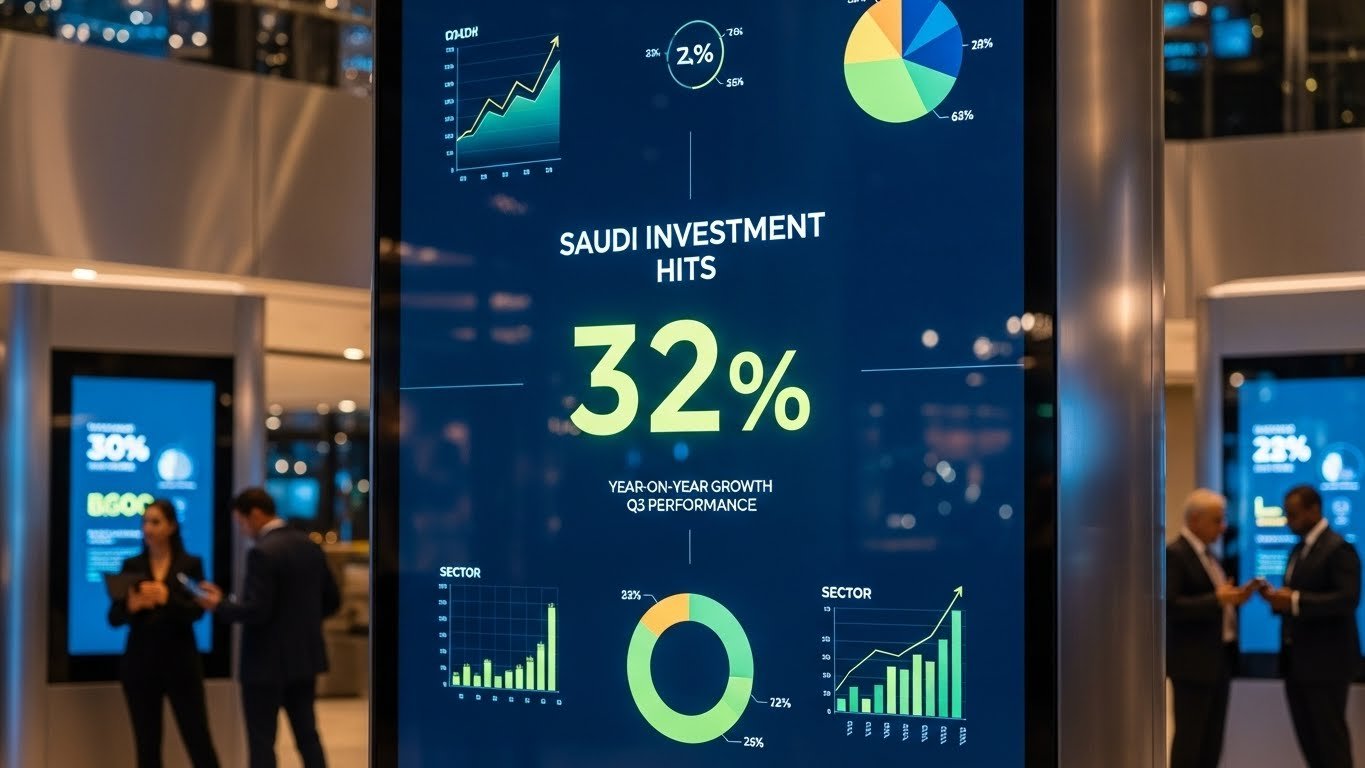
Saudi investment hits 32% economic transformation has entered a decisive phase, and the latest investment figures underline just how rapidly the Kingdom is reshaping its growth model. According to the minister’s recent remarks, Saudi investment has climbed to 32% of GDP, while non-oil fixed capital investment has reached 40%—a powerful signal that the diversification push is no longer just a policy ambition but a measurable economic reality.
For years, global observers have tracked Saudi Arabia’s shift away from reliance on oil revenues, largely driven by Vision 2030 and the National Investment Strategy. Now, these updated indicators show that the Kingdom is not only investing heavily, but also directing a significant share of that investment into non-oil sectors, building productive assets that can sustain long-term expansion. This matters because investment-to-GDP ratios reflect more than spending—they reveal how strongly an economy is preparing for the future by funding infrastructure, manufacturing capacity, technology, tourism, logistics, and energy transition projects.
In practical terms, rising Saudi investment means more construction activity, more industrial expansion, more private-sector opportunities, and a broader base for job creation. It also signals stronger confidence among domestic and foreign investors who are aligning their capital with the Kingdom’s policy direction. Most importantly, the rise in non-oil fixed capital investment suggests that Saudi Arabia is deepening its economic foundations, strengthening productive capacity rather than relying on short-term growth boosts.
This article explores what these figures mean, why they matter, and how the investment surge could shape Saudi Arabia’s economy over the next decade. You’ll also learn how Saudi investment supports productivity, innovation, and competitiveness, what’s driving capital formation outside oil, and what challenges still need to be managed to keep the momentum sustainable.
Understanding the headline numbers: 32% of GDP and 40% non-oil fixed capital
When policymakers highlight that Saudi investment hits 32% of GDP, they’re pointing to an unusually strong level of capital activity. Many advanced and emerging economies struggle to maintain investment levels above the mid-20% range for long periods. A sustained 32% investment-to-GDP ratio suggests that Saudi Arabia is in a major capital expansion cycle—similar to what fast-growing economies experience when building infrastructure and industrial capacity.
At the same time, the report that non-oil fixed capital reaches 40% carries a deeper meaning. Fixed capital formation refers to long-term assets such as factories, machinery, technology infrastructure, transport networks, ports, airports, hotels, housing developments, renewable energy plants, and industrial zones. When this investment shifts toward non-oil activities, it signals a structural transformation: Saudi Arabia is building assets that will generate income and productivity in industries that are not directly tied to crude oil production.
These numbers are also important because they reflect a strategic policy rebalancing. Saudi Arabia has long had the capacity to invest, but Vision 2030 aims to ensure that investment generates diversified sources of GDP, stronger exports, sustainable employment, and higher productivity. The minister’s statement indicates that the scale of capital deployment is now aligned with that long-term structural agenda.
In other words, Saudi investment is no longer just about spending money—it is about redirecting capital into the sectors that will define the Kingdom’s post-oil economy.
Why Saudi investment levels matter for economic diversification
Investment ratios often act as a leading indicator for future growth. When a country increases capital formation, it expands its productive capacity, improves infrastructure, and enhances competitiveness. That is why the announcement that Saudi investment hits 32% of GDP is so significant: it suggests that the Kingdom is laying down the economic foundations required for sustained output growth.
A strong investment-to-GDP ratio also reflects confidence. Investors—whether state-owned entities, private corporations, or foreign strategic partners—commit long-term capital only when they believe in stability, returns, and policy consistency. Saudi Arabia’s ability to sustain elevated investment levels indicates that markets see the Kingdom’s reforms as credible, and that the government’s planning is translating into real-world projects.
For the Saudi economy, higher investment matters in at least four major ways. First, it expands the capacity of non-oil industries, from tourism and entertainment to logistics and manufacturing. Second, it supports labor market growth by creating jobs in construction, services, engineering, technology, and industrial production. Third, it builds export potential, particularly in areas like petrochemicals, mining, and value-added manufacturing. Fourth, it increases resilience by reducing the economy’s sensitivity to oil price volatility.
Because the Kingdom’s long-term goal is to build a high-productivity economy driven by private-sector growth, Saudi investment is increasingly assessed not only by its volume but by its quality—where it goes, how productive it becomes, and how effectively it supports structural change.
The role of Vision 2030 in shaping capital allocation
Vision 2030 has effectively rewritten Saudi Arabia’s investment map. Rather than allowing capital flows to concentrate mainly around oil-related activity, the strategy actively targets high-impact sectors: tourism, logistics, fintech, clean energy, advanced manufacturing, real estate, healthcare, and digital services.
This explains why the minister’s statement about non-oil fixed capital reaching 40% is especially meaningful. It indicates that a large portion of Saudi Arabia’s productive asset-building is now happening in industries outside the traditional oil economy.
The policy approach behind Vision 2030 is also designed to create investment “multiplier effects.” A mega-project isn’t only about building a new city or tourism destination—it also creates supply chains, transport links, industrial demand, service sector growth, and technology adoption. Over time, the goal is that this web of activity becomes self-reinforcing, enabling non-oil GDP to grow sustainably and supporting new streams of exports and domestic value creation.
In this context, Saudi investment is best understood as a coordinated national program rather than a random set of projects. That coordination—through strategic planning, regulation, and institutional reform—helps explain why the Kingdom is able to scale investment volumes while maintaining direction toward diversification outcomes.
What is driving Saudi investment growth right now?
Several interconnected drivers help explain why Saudi investment has surged to 32% of GDP.
One driver is government-led capital spending, particularly in infrastructure, transportation networks, utilities, and strategic industries. This investment plays a catalytic role by improving the operating environment for private companies and enabling new business models in sectors such as tourism and logistics.
Another driver is institutional reform. Improved business regulations, streamlined licensing processes, stronger investor protection frameworks, and greater transparency can make an economy more investable, even when global conditions are uncertain. Saudi Arabia has focused heavily on building a more predictable and attractive investment environment, encouraging both domestic and foreign capital.
A third driver is the growing strategic role of major state-backed entities. The Kingdom’s investment arms have increasingly targeted sectors that can accelerate diversification, including technology, renewables, entertainment, and advanced manufacturing. When these projects move forward, they drive large-scale fixed capital formation—exactly the kind captured in the non-oil investment figures.
Finally, there is a global positioning driver. Saudi Arabia is increasingly positioning itself as a bridge economy connecting Asia, Africa, and Europe. This requires heavy investment in ports, logistics, aviation, industrial zones, and supply chain infrastructure. As these initiatives accelerate, they lift overall capital formation and deepen Saudi Arabia’s non-oil productive base.
Together, these forces make the current surge in Saudi investment not a short-lived spike, but a reflection of the Kingdom’s evolving economic structure.
Non-oil fixed capital at 40%: why this is a turning point
The declaration that non-oil fixed capital reaches 40% points to a key shift: more of Saudi Arabia’s long-term asset building is being directed toward non-oil industries rather than oil production itself. That reduces long-term dependency on hydrocarbons and increases the likelihood that future growth will come from services, manufacturing, and technology-led productivity gains.
Fixed capital formation is especially important because it shapes the economy’s future productive capacity. When investment builds airports, high-speed transport links, data centers, tourism resorts, or renewable energy farms, it creates assets that can generate economic value for decades. If these assets align with global trends—such as the growth of digital economies, clean energy, and tourism expansion—then they can help Saudi Arabia compete globally.
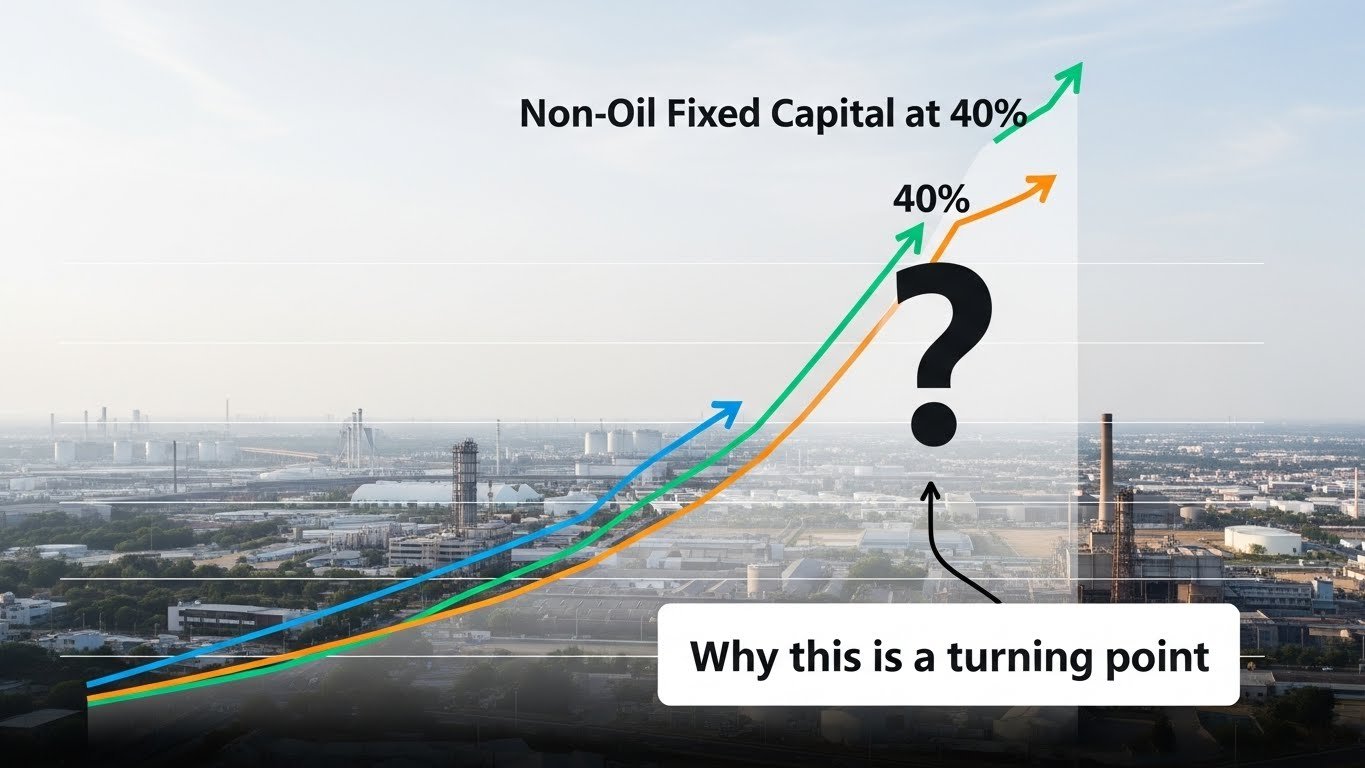
This is also crucial for employment. Oil production is capital intensive and does not create jobs at the same scale as services and diversified industries. By increasing non-oil fixed capital, the Kingdom is investing in job-rich sectors, supporting national employment objectives and expanding opportunities for young Saudis entering the workforce.
In many ways, non-oil fixed capital investment is the measurable backbone of diversification. It shows that Saudi Arabia is not only developing policies for a post-oil economy but is physically building the productive machinery needed to make that economy real.
The private sector’s growing role in Saudi investment
While public investment remains a major driver, the long-term sustainability of Saudi Arabia’s investment surge depends heavily on private-sector expansion. A healthy economy cannot rely only on state-driven projects; it needs competitive companies, strong entrepreneurship, and consistent foreign investment flows that help scale capacity and introduce global expertise.
Saudi Arabia’s reforms aim to ensure that Saudi investment increasingly becomes private-led over time. This includes attracting multinational corporations, encouraging local manufacturing and services development, and strengthening capital markets so firms can fund growth efficiently.
Private-sector participation also improves efficiency. When companies invest based on market signals and profitability, capital tends to flow into productive areas, supporting innovation and competitiveness. The government’s role becomes enabling—providing infrastructure, regulation, and strategic guidance—while private firms drive operational execution and job creation.
This is why the minister’s emphasis on non-oil fixed capital investment is strategically important. Non-oil sectors typically provide more room for private participation than upstream oil production, enabling the private sector to become a larger contributor to investment totals.
Over time, this should increase productivity, expand export capacity, and strengthen economic resilience—key goals of Vision 2030.
Foreign direct investment and the credibility factor
Foreign direct investment (FDI) matters because it brings more than money. It brings technology, management expertise, global networks, and the ability to integrate local production into international supply chains. For Saudi Arabia, stronger investment metrics can also improve international investor sentiment by demonstrating that the economy is expanding its productive base beyond oil.
When international partners see that Saudi investment hits 32% of GDP and non-oil fixed capital continues rising, it can reinforce confidence that the Kingdom is committed to long-term transformation rather than short-term spending.
FDI is especially important for sectors like advanced manufacturing, renewable energy, pharmaceuticals, logistics, cloud computing, and specialized tourism. These industries often require global know-how and deep supply chain integration. By raising investment volumes and improving the business environment, Saudi Arabia can improve its attractiveness as a destination for long-term foreign capital.
The credibility factor here is simple: sustained investment sends a signal that Saudi Arabia is serious about building an economy with world-class infrastructure, high standards, and future-ready sectors.
How Saudi investment supports employment, skills, and productivity
Investment is often talked about in terms of GDP contribution, but its most visible impact for society is employment and skills development. Large-scale investment creates construction jobs initially, but the long-term benefit comes when new industries sustain employment across services, operations, management, and technology.
If non-oil fixed capital continues to expand, job creation can accelerate in tourism, retail, hospitality, transport, logistics, finance, and digital industries. These sectors not only create employment but also increase opportunities for specialized training, skill development, and career mobility.
Investment also boosts productivity. When companies operate with modern logistics networks, digital infrastructure, and efficient industrial zones, they can produce goods and services faster and more competitively. Productivity gains are essential for sustainable wage growth and for improving Saudi Arabia’s competitiveness in global markets.
This is why Saudi investment is closely linked to the broader Vision 2030 social agenda: higher labor force participation, improved private-sector wages, stronger human capital, and expanded opportunities for youth and women.
The macroeconomic balance: managing high investment sustainably
A major investment boom is powerful, but it must be managed carefully to avoid overheating, inefficiency, or fiscal stress. When investment rises sharply, economies can face supply constraints, cost inflation, labor shortages, or project execution challenges. To sustain progress, Saudi Arabia must balance speed with efficiency.
This means prioritizing high-impact projects, ensuring realistic timelines, and maintaining strong governance to reduce waste. It also means aligning investment with long-term returns rather than short-term visibility. Not all projects contribute equally to productivity or export potential, so careful selection matters.
Financing strategy also matters. If investment is funded through stable long-term capital structures, deep capital markets, and predictable public finance planning, it becomes more sustainable. But if it relies too heavily on short-term borrowing or unpredictable fiscal conditions, risks can rise.
The minister’s statement on investment ratios suggests strong momentum, but sustaining that momentum will require ongoing reforms, strong project management, and continued private-sector expansion to reduce reliance on public funding.
What these numbers mean for the future of the Saudi economy
The current figures suggest that Saudi Arabia is moving toward a new economic identity. If Saudi investment remains high and non-oil fixed capital continues to rise, the Kingdom could reach a point where non-oil sectors become the dominant driver of growth, employment, and exports.
That shift would mean greater resilience to oil price cycles and a stronger base for long-term fiscal stability. It would also mean that Saudi Arabia’s economic story becomes less about commodity revenue and more about productivity, innovation, services, and advanced industries.
Over the next decade, the real question will not be whether Saudi Arabia can invest at scale—it clearly can—but whether it can convert that investment into sustainable returns, globally competitive industries, and strong human capital outcomes. If it succeeds, the current numbers—32% of GDP investment and 40% non-oil fixed capital—may be remembered as the turning point when the transformation became irreversible.
Conclusion
The minister’s announcement that Saudi investment hits 32% of GDP and non-oil fixed capital reaches 40% highlights the scale and seriousness of the Kingdom’s economic transformation. These figures point to a country investing aggressively in its future—building infrastructure, expanding non-oil industries, strengthening the private sector, and laying the foundation for long-term diversification under Vision 2030.
The significance goes beyond percentages. Strong Saudi investment levels indicate confidence, planning, and momentum, while the rise in non-oil fixed capital shows that the investment is increasingly focused on productive assets that can sustain growth for decades. The next chapter will depend on execution quality, private-sector participation, and the ability to turn large-scale capital formation into higher productivity, stronger exports, and broad-based job creation.
If Saudi Arabia maintains this trajectory, it will not only diversify its economy, but also position itself as a major global investment and business hub—built not on oil alone, but on competitive non-oil industries and future-ready economic infrastructure.
FAQs
Q: What does it mean that Saudi investment hits 32% of GDP?
It means that total investment spending in Saudi Arabia—across government, private sector, and strategic projects—equals about 32% of the country’s annual economic output. This is a high level that typically signals strong economic expansion and large-scale capital formation.
Q: Why is non-oil fixed capital reaching 40% such a big deal?
Because it shows Saudi Arabia is building productive assets in sectors beyond oil, such as logistics, tourism, manufacturing, technology, and renewables. This is essential for long-term diversification and reduced dependence on oil revenues.
Q: How does Saudi investment support Vision 2030 goals?
Saudi investment funds the infrastructure and industries needed to expand non-oil GDP, create jobs, improve productivity, and attract foreign companies—core targets of Vision 2030.
Q: Will higher investment automatically lead to higher economic growth?
Not automatically. Investment must be productive and efficiently executed to generate long-term returns. High-quality projects, strong governance, and private-sector participation determine whether investment translates into sustainable growth.
Q: Which sectors are likely benefiting most from the rise in non-oil investment?
Key beneficiaries typically include tourism and hospitality, logistics and transport, manufacturing, mining, renewable energy, real estate development, and digital infrastructure—areas central to building a diversified economy.
